
From Quarry to Cemetery Monuments
References & Resources
- 1889 Vermont Marble Company Price List:
Rutland, Sutherland Falls, & Dark
Marble, Proctor, Vermont, 415 pp. (cemetery stones, monuments,
and accessories) Due to the size of this book, I have broken the
book into 4 sections in PDF. You can click on the thumbnail image
of the “Index” page
below to find the section of the book you wish to view, and then
you can click on one of the following PDF links to view that section — Part
1. Title
page through pp. 99 (about 14 MB) — Part
2. pp.
100-199 (about 14 MB) — Part
3. pp.
200-299 (about 14 MB) — Part 4. pp.
300-415 (17+ MB). Peggy
B. Perazzo


Title Page
Index / Contents
- “A Half Hour With Our Designers,” A student of naval architecture who has become a foremost designer and delineator of cemetery memorials for the trade. Part 3, Granite Marble & Bronze, Vol. XXXI, No. 4, April 1921, pp. 29-36. The article begins: “The interesting careers of numerous architects and talented designers in the field of memorial art bespeak the remarkable evolution of our craft from a trade into a great industrial art. The character of present-day memorial design is commanding respect and recognition in circles which have heretofore been disposed and depreciate and scorn the craft by destructive criticism and derision. Since the closing years of the 19th century the influence of our designers has been largely responsible not only for the renaissance of good art but as well for the economic expansion of the industry….” (Article about L. A. Whitehouse of Quincy, Massachusetts.)
- A Monument Speaks, by Irene Dindo Podskainy, Adams Granite Co., P.O. Box 126, Lewis Street, Barre, Vermont, 1961. (Today the Adams Granite Co. is known as Adams North Barre Granite.)
- Aggregate Stone, on Wikipedia.
- Alphabetical List of California Stone Carvers section of the “Historical California Cemetery Stone & Monument Carvers & Dealers Historical Research” on this Stone Quarries and Beyond web site.
- “American Cemeteries are Pagan − Impressions of a Foreign Visitor,” in The Monumental News, Vol. 7, No. 6, June 1895, pp. 366-368.
-
American Stone Books, Ian Berke Collection – Books made of stone. (Used with Permission. Once you reach Ian’s American Stone Book web site, scroll down to see his beautiful collection of stone books.)
As of July 2015, there are photographs of about 365 stone books presented on Ian Berke’s American Stone Book web site. These stone books displayed on his web site are in his collection, and he states he will continue to add to the collection and web site.
According to Ian Berke:
“Carved stone books are a fascinating and unusual form of American folk art. They were given as tokens of affection, and the most interesting have inscriptions and carving. Often there are first names, usually female. Full names are much less common presumably because the giver likely knew the recipient well. Dates appear as well, which indicates the popularity of these books decade by decade. The first American stone books show up about 1860, including books carved by soldiers during the Civil War, but seem to be most popular from 1870 to 1900. The latest in this collection is from 1931. Judging from the quality of much of the carving, many books were probably made by professional stonecutters or monument makers. Others were obviously done by amateurs. Some were intended as souvenirs, to be sold to tourists at attractions such as Garden of the Gods (Colorado).
“Typically the books were carved from marble, often white, because it was widely available and easy to carve compared with igneous rocks. Slate, sandstone, limestone, agate, and pipestone are also seen….”
A much longer article entitled “Carved in Stone: American Stone Books,” by Ian Berke, published in the April 2015 issue of the Maine Antique Digest, is available.


“Clasped Hands” Stone Book, Ian Berke, American Stone Books (Used with permission)
“Linked Chain” Stone Book, Ian Berke, American Stone Books (Used with permission)
“Tintype of Harry” Stone Book, Ian Berke, American Stone Books (Used with permission)


“Clapsed Hands” Stone Book, Ian Berke, American Stone Books (Used with permission)
“Maltese Cross 1876” Stone Book, Ian Berke, American Stone Books (Used with permission)
“Dove with Olive Branch” Stone Book, Ian Berke, American Stone Books (Used with permission)
- American Stone Trade Magazine, published by American Stone Trade Company, Chicago, Illinois. (Available on Google Books)
-
“An Historic Epitaph Book Inherited by an English Monument Firm,” The Monumental News, Vol. XIX, No. 2, February 1907, pp. 171-172.
The article begins: “Mr. Frank Watts, a monument dealer in London, sends us an interesting and unique old book of hand-written epitaphs, that was used several generations ago in the business now conducted by Mr. Watts before epitaphs books began to be printed.
“It is an historic old volume, faded and ragged with age, and contains some of the originals of the quaint old English epitaphs, man of which have been seen in the old cemeteries in this country….”
- “Antietam Memorials” Brochure, Pangborn Corporation, Hagerstown, Maryland.
- “Art in Bronze-Work,” Harper’s Weekly, April 23, 1904, pp. 635.
- “The Art of the Monument in 1921” A critical review of the changing Aspects of Monumental Design, by Ernest Stevens Leland, in The Monumental News, Vol. 34, No. 1, January 1922, pp. 28-31.
- The Association For Gravestone Studies
- Association
For Gravestone Studies Archives (From
the web site: “The AGS Archives contains collections donated
primarily by members, and includes books, research papers, photographs,
postcards, articles, and other gravestone related materials. In
April 2009, the AGS Board voted to transfer our Archives to the Department
of Special Collections, University of Massachusetts , Amherst ….”
- Association For Gravestone Studies Collection (1975-2008), located at the University of Massachusetts, W.E.B. Du Bois Library, Amherst
- Association For Gravestone Studies Lending Library
- External Links for the United States & Other Countries (relating to cemetery stones)
- “‘Back in the Olden Days’ A Stone Cutter and His Trade,” by Charlote Cole, Manuscript student paper, 1979, Regional Studies Center at Lyon College, Batesville, Arkansas. [Note: a transcription of Cole’s taped interview with P.E. Stone, tombstone carver, is also available. The paper includes Cole’s drawings of Stone’s carving tools, a copy of a Pfeiffer Stone Company, Batesville, Ark. pamphlet titled “Crystalline Oolitic Marble ‘Arkansas White’” and excerpts from the Padgett Marble Company, Knoxville, Tennessee, Catalog No. 26, 1930.]
- Bell Marble Works Quarry Photographic Tour (located on the Marble Quarry RV grounds – open to the public)
- Benicia Arsenal Photographic Tour
- Berkeley Granite Company, Elberton, Georgia – Wholesale Price List, Berkeley Blue Memorials, 1952 Design Series (cemetery stone and mausoleum catalog)
- “Best Monumental Types of the Year,” in The Monumental News, Vol. 34, No. 1, January 1922, pp. 20-27.
- “Best Types of American Memorial Art” III. The Celtic Up-Right Cross Slab,” by Ernest Stevens Leland, The Monumental News, Vol. XXIX, No. 5, May 1917, pp. 274-277.
- Book of Epitaphs (circa 1890s) (pdf) - Provided by Office of S. B. Sargent, Manufacturer of & Dealer in All Kinds of Marble & Granite Work, Tilton, New Hampshire (The title and date of publication are unknown, although the S.B. Sargent company is listed in an 1893 publication. The last half of the booklet is in German.)
- Brunner and Lay Tool Catalog - Brunner & Lay, Manufacturers of Marble, Stone, Granite and Bricklayers’ Tools, Stone Jacks, Derricks, and Contractors’ Supplies, 570 West Polk Street, Corner Jefferson and Polk Streets, Chicago, Illinois. (No date of publication)
- “The Building Stone and Aggregate Industry of the San Francisco Bay Counties,” by Mort D. Turner, in Geologic Guidebook of the San Francisco Bay Counties, Bulletin 154, State of California Dept. of Natural Resources, Division of Mines, San Francisco, pp. 235-238.
- California Historic Cemetery Alliance: Protecting, Restoring, Educating, Preserving (CHCA), Dr. Bob LaPerriere, Chairman.
- “Carvers of Carroll County” (Arkansas), by Abby Burnett and Vineta Wingate, Carroll County Historical Quarterly 53 (Sept. 2008): 22-26, 47.
- “Cemeteries,” on Wikipedia. (Includes many photographs of marble cemetery stones around the world.)
- Cemetery Monument Designs Advertisement by The Monumental News, November 1895, pp. 717.
- Cemetery Monuments Made of Zinc, by Carol A. Grissom, Senior Objects Conservator, MCI, presented by the Smithsonian Museum Conservation Institute.
- “The Cemetery of the Innocents, Paris” (France), by William Walton, The Monumental News, Vol. XVIII, No. 2, February 1906, pp. 142-143.
- “Charles B. Canfield and His Work,” in The Monumental News, January 1896, pp. 24-25.


 |
 |
 |
“Superb composition, utter refinement in detail and exquisite ornamentation are qualities in the work of Whitehouse observe the scale and beauty of the family name.” |
“In combining realistic ornament with the abstract, Mr. Whitehouse has in this Gothic composition revealed his resourcefulness and good taste in a difficult problem.” |
“The masterful fusion of Gothic, Celtic and Naturalistic details; the appealing beauty of the shrine-like tablet; the superb pen and ink technique of the renderings. These are qualities which here bespeak the genius of L. A. Whitehouse, the designer and the delineator.” |
 |
 |
 |
“Mr. Whitehouse attains massive dignity without sacrificing the singular refinement sensitive proportioning and flow of line which characterizes his work.” |
“The architectural dignity of this impressive screen suggests the originality of Mr. Whitehouse in classic design.” |
“Mr. Whitehouse excells in the design of moderate priced memorials. Horizontal tablet forms akin to this example are among his notable contributions to the art of the monument.” |
 |
 |
“A prototype of many subsequent exhedra-screens, the Wilcox memorial bespeaks the jewel-like qualities of his work as an ornamentist.” |
“L. A. Whitehouse, Quincy, Massachusetts. Beside the model of Virgin and Child for a memorial he designed.” |
 |
 |
 |
“Cross in Memory of Stephen Clare.” (1895) |
“The Maude Cross.” (1895) |
“Cross in Memory of John A. Smith.” (1895) |


 |
 |
“An Epitaph book 250 years old.” |
“Fac-simile of page in old epitaph book.” |
 |
 |
 |
Front cover of Wholesale Price List, Berkeley Blue Memorials, Berkeley Granite Co., Elberton, Georgia |
First page of Wholesale Price List, Berkeley Blue Memorials, Berkeley Granite Co., Elberton, Georgia |
One of the pages in the Wholesale Price List, Berkeley Blue Memorials, Berkeley Granite Co., Elberton, Georgia |
 |
 |
 |
“Celtic headtones in Scotland and Wales.” (p p. 274) |
“Erect cross slab in Aberlemno churchyard.” ( pp. 276) |
“Vine Scrolls, S. Apollinare Nuovo, Ravenna.” & “Key Pattern, Ravenna.” (pp. 274) |
 |
Cemetery Designs Advertisement by The Monumental News, |
The article begins: “The ancient church and cemetery of the Saints-Innocents of Paris was one of the most celebrated monuments of the medieval city, and in the details of its history may be found some of the most striking characteristics of the manners and customs of the so-called dark ages….”
- Charles Clements, Wholesale Granite Dealer – New Style Rock Work, 1890s, 372-378 Boylston Street, Boston, Massachusetts – 36 La Salle Street, Chicago, Illinois – Quarry, West Quincy, Mass. – Foreign Office, Aberdeen, Scotland.
- Charles F. Earl & Co., American & Foreign Granites & Italian Statuary Monument Catalog, 339 Genesse St., Utica, New York (no date of publication)
 |
 |
 |
Charles B. Canfield, proprietor of Batterson, Canfield, & Co. (Hartford, Conn.), & New England Monument Co., New York City (1896, The Monumental News) |
A part of the William Henry Gunther Monument, Greenwood Cemetery, Brooklyn, New York, from "Charles B. Canfield and His Work," The Monumental News, Jan. 1896 |
The Chester A. Arthur memorial in the Albany Rural Cemetery, Albany, New York (1896, The Monumental News) |
 |
 |
 |
Monument in the article, "Charles B. Canfield and His Work," The Monumental News, Jan. 1896 |
The Goodrich obelisk in Rose Hill Cemetery, Chicago from "Charles B. Canfield and His Work," The Monumental News, Jan. 1896 |
A monument designed by Charles B. Canfield from "Charles B. Canfield and His Work," The Monumental News, Jan. 1896 |
According to this article: “The subject of this sketch, Mr. Charles B. Canfield, was born in Hartford, Connecticut… and his connection with the monumental business dates back from 1852, when he began as bookkeeper and salesman in an establishment in the city of his birth, in which he subsequently became a partner, under the firm name of Batterson, Canfield, Co.
“From those days up to present - when as proprietor of the New England Monument Co., New York City, he has become known to a wide circle of friends and business acquaintance, he has been a busy man, travelling unrecorded thousands of miles from east to west and from north to south of his own broad land, besides making several trips abroad….”
“Passing to his work…no other designer has produced so many designs that have become…standard…Take for instance the ‘Probasco’ sarcophagus, the ‘Murphy’ and Wilshire’ obelisks, the ‘Ringold’ statue and pedestal, all in Spring Grove Cemetery, Cincinnati, Ohio, and all dating back twenty-five years or more….”
“That Mr. Canfield has progress in his art, the same argument may be cited and applied to the ‘Goodrich’ obelisk, in Rose Hill Cemetery, Chicago….”
 |
 |
 |
Front cover of the Charles F. Earl & Co., American & Foreign Granites & Italian Statuary |
Display of dies & bases in the Charles F. Earl & Co., American & Foreign Granites & Italian Statuary monumental catalog |
Display of Monument No. 610 in the Charles F. Earl & Co., American & Foreign Granites & Italian Statuary monumental catalog |
- “Churchyard,” on Wikipedia.
- “Citation List of Leeanna Rossi’s Research Notes (regarding Gold Rush Area Stone Carvers & Companies),” compiled by Leeanna Rossi.
- City of the Silent – Cemetery Culture, by Joel GAzis-SAx
- Columbia, Tuolumne County, California, Quarries Photographic Tour
- “John W. Combs – The life story of John William Combs,” by Ruth Combs Edvalson, his Granddaughter, 2000.
- Colusa County Sandstone Quarries – the Knowles/Brownstone Quarry & the inactive McGilvray sandstone quarry photographic tour.
- “Comparison of Puritan and Grecian Monumental Art,” in The Monumental News, May 1893.
- “Construction Aggregate,” on Wikipedia.
- “Curiosities in Epitaphs,” Stone, An Illustrated Magazine, June 1892, pp. 54-55 & “Some More Curiosities in Epitaphs,” Stone, An Illustrated Magazine, August 1892, pp. 278 (Locations mentioned in these articles include: the West Street Cemetery, Fairhaven, Vermont; unnamed cemeteries in West Haven, Vermont; Hampton, New York; Pawlett, Vermont; and a tomb in Saragossa, Spain)
-
“Lucy J. Daniel (1865 - ?),” by Abby Burnett, Encyclopedia of Arkansas History & Culture, updated 2011
- Davis Cemetery District, Yolo County, California.
- Design Hints For Memorial Craftsmen, published monthly at St. Cloud, Minnesota, by Dan Haslam between 1924 and 1934. (Many of the issues of Design Hints for Memorial Craftsmen are available on this web site from 1926 through 1932. Peggy B. Perazzo)
- “Designing and Lettering,” By Dan B. Haslan at Iowa Convention,” by Dan B. Haslan at Iowa Convention, in The Monumental News, Vol. 35, No. 4, April 1923, pp. 214-216.
- “Developing and Selling a Special Design” (the Wilbur F. Young, Esq., Monument), by Robert L. Cook, from The Monumental News, Vol. XXXI, No. 9, September 1919, pp 616-618.
- “Diary of a Headstone,” from The Monumental News, Vol. XIX, No. 2, February 1907, pp. 165.
- “Dimension Stone,” on Wikipedia.
- “Dimension Stone – Statistics and Information,” presented by the U. S. Geological Survey.
- “Distribution in Time, Provenance, and Weathering of Gravestones in Three Northeastern Ohio Cemeteries,”Andrew Bauer, Joseph T. Hannibal, Claudia Britt Hanson, and Jesse V. Elmore, Cleveland Museum of Natural History, Ohio Journal of Science, Vol. 102 (4), 2002, pp. 82-102.
- Eaton Studio – The F. C. Eaton, Barre, Vermont, Monumental Catalog – early 1900s (“We take pleasure in bringing to your notice the Barre Granite Manufacturers represented in this book, each manufacturer having a page with 12 original designs….” List of manufacturers: Giudici Bros., J. A. Martinson; Bond & Kidder; Burke Bros. ; Eclat Granite Co. ; Littlejohn; Odgers & Milne; C. Bianchi & Sons, Abbiati & Bros.; McMillan & Son; and North Barre Granite Co. (on the inside back cover of the book there is a sticker that reads: “Tell ‘em you saw it in Rock Products, 355 Dearborn St., Chicago, Ill., Quarry and Monument Trade”)
 |
“Diary of a Headstone,” 1907 |
 |
 |
Front cover of the F. C. Eaton, Barre, Vermont, monumental catalog |
Inside front cover listing the companies whose monuments are included in this catalog |
 |
 |
 |
|
Three examples of the monuments presented in the F. C. Eaton, Barre, Vermont, monumental catalog |
|
- “Epitaph,” on Wikipedia
- Epitaphs (booklet in pdf), by the Vermont Marble Company, Proctor, Vermont, early 1900s, presented on this Stone Quarries and Beyond web site.
- F. Barnicoat: High-Grade Granite Statuary and Monuments (pdf), Office and Studio, Intervale Street, Quincy, Massachusetts, 1903, 24 pp.
 |
 |
 |
Front cover of F. Barnicoat Statuary and Monument Catalog, 1903 (pdf) |
One of the monuments presented in the F. Barnicoat Catalog (pdf) |
Examples of statuary presented in the F. Barnicoat Catalog (pdf) |
- Flint Granite Co. Monument Catalog, circa 1905 – Flint
Granite Company, Builders of Artistic Memorials in Granite,
Marble and Bronze (Monument
Catalog) (PDF), circa 1905, 34 pp.

-
“Foundations” (in Monumental Work), (Scroll down to the 2nd article.) in The Monumental News, Vol. 7, No. 7, July 1895, pp. 423-424.
This article on “Foundations” begins as follows: “in the erection of monumental work there is no generally accepted standard for foundations. Modern cemeteries have adopted rules and regulations governing their construction, but they differ so widely….”
- Georgia – Special Granite Designs in the Famous Pride of Elberton Blue Granite, Design Book No. 16, 1920’s & Price List for Special Granite Designs, No. 16-H (pdf), 1920’s. (Monument catalog and price list for Elberton Blue Granite monuments from Georgia)

 |
 |
Foundations in Monumental Work – Examples A & B (1895) |
Foundations in Monumental Work – Examples C & D (1895) |
 |
 |
Foundations in Monumental Work – Examples E & F (1895) |
Foundations in Monumental Work – Example G (1895) |
 |
 |
 |
Special Granite Designs in the Famous Pride of Elberton Granite, Design Book No. 16 (front cover) |
One of the monuments in the Special Granite Designs in the Famous Pride of Elberton Granite, Design Book No. 16 monument catalog |
Price List for Special Granite Designs, No. 16-H (front cover) |
- Georgia Beauties: Catalog Number Twenty-Two (pdf), The Georgia Marble Finishing Works, Builders of Fine Monuments, Canton, Georgia (no date of publication – possibly 1940s – catalog of cemetery monuments, urns, and vases) Georgia Marble Company November 1974 Price List (pdf) (Price list of designs illustrated in Georgia Marble Finishing Works design Book No. 22.)
 |
 |
 |
Front cover of Georgia Beautifies: Catalog Number Twenty-two |
The Amtry cemetery monument in |
Airplane view of the present plant of The Georgia Marble Finishing Works, with the Etowa River in background (pp. 40) |
-
Granite, Vol. XII, No. 1, January 1902, A. M. Hunt & Co., Publishers, 131 Devonshire St., Boston, Mass.
- “Granite,” on Wikipedia. (Includes a photograph of a granite cemetery stone.)
- Granite Magazine, published by A. M. Hunt & Co., Publishers, Boston, Massachusetts. (Available on Google Books)
- The Granite Cutters’ Journal Magazine, Vol. 34, 1910, and Vol. 35, 1911 (with more to come) (available on Google Books – Full View Books.)
- Granite, Marble & Bronze Magazine, published by A. M. Hunt & Co., Publishers, Boston, Massachusetts. (Several issues of this magazine are available on Google Books – Full View Books.)
-
Granite Marble & Bronze Magazine – Memorial Art, by Hugo Elliott, Cambridge, Granite, Marble & Bronze, Massachusetts, The Warren Publications Press, 1923. (The following quotation is from the Forward in this book: “The material contained in the following pages was first published in monthly installments in Granite Marble & Bronze….”) (Available on the Internet Archive)
- “Grave (Burial),” on Wikipedia.
- “Grave Markers,” on Wikimedia Commons (Contents: Gravestones: Columns, crosses, obelisks, grave stars; External tomb chests; Grave sculptures: Bronze grave sculptures, Church monuments, and Funerary monuments in Islamic mausoleums; Regionally specific grave markers: Grave lanterns, Gorintōs, Grave orbs, and Kopjafa; Other materials: Wooden grave markers, Metal grave markers (Iron and Bronze); Grave markers by country; and Grave markers by occupant.)
- Graves, Tombs, and Cemeteries Photographs on Flickr
- Gravestone & Cemetery Preservation Past, Present & Future
- Gravestone
Symbols
-
Gravestone Symbolism, on TheCemeteryClub.com web site.
-
Gravestone Symbolism, presented on the Grave Addiction web site.
-
Gravestone Symbol Images, on Bing
-
Gravestone Symbols and Their Meanings, presented on the Ringgold County, Iowa, CAGenWeb Project web site.
-
Gravestone Symbols and Carvings – Meaning and Inspiration, Posted 06/01/15 in The Headstone Guide, by Fergus Wessel, Stoneletters Studio, Oxfordshire, UK
-
Tombstone Symbols & their Meanings, presented on the United States Genealogy & History Network
-
- “Graveyard,” on Wikipedia. (Information and photographs of graveyards around the world are included.)
- “A Greenland Cemetery,” by James D. Dewell, in The Monumental News, August 1895, pp. 492-493. (This article is about a cemetery at the harbor of Sukkertoppen (Sugar Loaf), Greenland, July 1894. “…a settlement of four hundred Esquimaux under the Danish flat, a race without a history of a nationality; a people of Asiatic cast, whose progenitors were probably from a warmer clime.”)
- “Greenwood Cemetery,” by William Howe Downes (located in Brooklyn, New York), The Monumental News, Vol. 8, No. 1, January 1896, pp. 26-28.
- A Handbook of Ornament: With three hundred plates, containing about three thousand illustrations of the elements, and the application of decoration to objects, by Franz Sales Mever, First American Edition, New York: The Architectural Book Publishing Company, 1920s ?, 548 pp. (Contents: “Elements of Decoration,” The Geometrical Elements, Natural Forms, Artificial Objects; “Ornament Applied to Features,” “Decorated Objects,” Vases &c., Metal Objects, Furniture, Frames, Jewelry, Heraldry.) (This book is available for reading on the Internet Archive web site.)
- Harrison Granite Company Clientele Catalog (& Monuments) (pdf), Harrison Granite Company, Established 1845, 200 Fifth Avenue, New York City, Quarries & Works: Barre, Vermont, January 1, 1918, 24 pp.
 |
 |
 |
Front cover of Granite magazine, January 1902 |
The Troy White Granite Co. advertisement in of Granite magazine, January 1902 |
The Beecher cemetery monument in of Granite magazine, January 1902 |
 |
 |
 |
Greenland Cemetery, looking south, from “A Greenland Cemetery,” The Monumental News, August 1895 |
Greenland Cemetery, “Opening Graves,” from “A Greenland Cemetery,” The Monumental News, August 1895 |
“Lutheran Church,” from “A Greenland Cemetery,” The Monumental News, August 1895 |
 |
 |
 |
Entrance to Greenwood Cemetery, Brooklyn, N.Y. (The Monumental News, Jan. 1896) |
One of the lakes in Greenwood Cemetery, Brooklyn, N.Y. (The Monumental News, Jan. 1896) |
“Monuments in Greenwood Cemetery, Brooklyn: Charlotte Canda, The Old Sea Captain, James Gordon Bennett.” (The Monumental News, Jan. 1896) |
 |
 |
 |
Front & back covers of the Harrison Granite Co. Clientele & Monument Catalog |
Title page of the Harrison Granite Co. Clientele & Monument Catalog |
Letter from the Harrison Granite Co. to a customer dated June 1921 |
- “Headstone” on Wikipedia (Includes information on fieldstones, granite, marble and limestone, sandstone, slate, iron, white bronze, and wood markers.)
- Headstones of the Gold Rush Era: Sculpting Masterpieces in Marble, by Leeanna Rossi, Golden Notes, Vol. 43, Number 3, Fall 1997, Sacramento County Historical Society, Sacramento, California, 1997. (The booklet can be obtained from the Old Sacramento City Cemetery.)
- Headstones, on headstones.net.
- Historic Headstones
- Historical California Stone Carvers, Stone Cutters, & Monument Dealers, on the Stone Quarries and Beyond web site.
- “History of Burial Practices,” presented on the Encyclopedia of Death and Dying.
- History of Capay Valley Cemetery District with a note on the older Cemeteries of Capay Valley, by Mark Riley, Capay, California.
- “History of Cemetery Memorial Art,” “Summary of an address before the National Retail Monument Dealers’ Convention at Milwaukee, by S. F. Duffield, illustrated with forty-five stereopticon views, from The Monumental News: Marble – Granite – Stone – Bronze – Sculpture, Vol. XXVI, No. 9, Chicago, September 1914, pp. 579-582 and front cover.
- “History of Cemetery Memorial Art,” in The Monumental News Magazine, September, 1919, pp. 579-582, presented on this Stone Quarries and Beyond web site.
- History of Government Furnished Headstones and Markers, presented by the U. S. Department of Veterans Affairs.
- Indian Diggings Cemetery and Indian Diggings Marble Quarry Area – Visit to the Indian Diggings Cemetery and Indian Diggings Marble Quarry Area in the Summer of 2003, on the Stone Quarries & Beyond web site.
- John Silva of Silva Memorials, Antioch, California – 1997 Interview
- “Kruegers of The Pfeiffer Stone Company” (Arkansas), by Wilson Powell, The Independence County Chronicle 15 (July 1974): 13 - 35.
- “Late Nineteenth Century Tombstone Iconography As Illustrated Through The Works of H. J. Wiebusch, Stone Carver, Independence County, Arkansas,” by Roberta D. Brown, The Independence County Chronicle, 25 (October 1983 – January 1984): 2-18.
- Lettering in Marble: A few plates and a few words of explanation – all bearing on the subject of lettering as it applies to the memorial trade, issued by the Vermont Marble Company, Procter, Vermont (in pdf format), presented on this Stone Quarries and Beyond web site.
- “Lists of Cemeteries by Country,” on Wikipedia.
- “Lost Grave Houses of the Arkansas Ozarks,” by Abby Burnett, Madison County Musings 27 (Winter 2008): 181-186.
- Maintenance of Interior Marble (pdf), by D. W. Kessler, Research Associate, National Bureau of Standards, Compliments of Carthage Marble Corporation, Carthage, Missouri, Published by National Association of Marble Dealers, 648 Rockefeller Building, Cleveland, Ohio (no date of publication in the booklet – possibly early 1900s) W. D. Carol, Sales Representative, P.O. Box 945, Columbus, Ohio.

Maintenance of Interior Marble, Carthage Marble Corp., Carthage, Missouri
- The Manual of Monumental Lettering, published by Monumental News, early 1920s.
- “Marble,” on Wikipedia.
- Marble
Color Plates: Imported and Domestic Catalog (pdf;
6 MB), Vermont Marble Company, Proctor, Vermont, no date
of publication,
possibly early/mid-1900s, 50 pp.


Title Page of “Marble Colorplates” Catalog, Vermont Marble Co.
List of Marble Color Plates in Catalog
- “Marble in America, Part 1: The Industry” & “Marble in America Part II: Marketing and Perception,” by Eva Schwartz, in “Focal Points” on the Barbara Israel Garden Antiques web site. Companies mentioned in the article include: Vermont Marble Company; Sutherland Falls Marble Company, Proctor, Vermont; and Producers Marble Company – all of Proctor, Vermont; and Colorado Yule Marble Quarry, Marble, Colorado.
- Marble Sample Box by the Vermont Marble Company (pdf) (The below images of the marble samples, the box (below), and accompanying literature are available for viewing in pdf.) The box was produced by the Vermont Marble Company of Proctor, Vermont. The Vermont Marble Company was one of the largest and oldest suppliers of cemetery stones across the United States. (Presented on this Stone Quarries and Beyond web site.)
- Marble Statuary (pdf), Vermont Marble Co., Proctor, Vermont,no date of publication, 7 pp. (Includes many photographs of the statuary sold by the Vermont Marble Company in addition to a list of their offices and branch finishing plants)

 |
 |
 |
Title page of The Manual of Monumental Lettering, published by Monumental News, early 1920s |
Page from The Manual of Monumental Lettering, published by Monumental News, early 1920s |
Page from The Manual of Monumental Lettering, published by Monumental News, early 1920s |


 |
 |
 |
Front cover |
Religious statues available from the Vermont Marble Co. Marble Statuary brochure |
“Marble for the Church” & the Vermont Marble Company office and plant locations |
- The Marble-Workers’ Manual. Designed for the Use of Marble-Workers, Builders, and Owners of Houses. Containing practical information respecting marbles in general; their cutting, working, and polishing; veneering of marble; painting upon and coloring of marble; mosaics; composition and use of artificial marble, stuccos, cements, receipts, secrets, etc., etc. (1856) Translated from the French, By M. L. Booth, with an Appendix Concerning American Marbles. Sheldon, Blakeman & Co., New-York, 1856.
- Markers: Annual Journal of the Association for Gravestone Studies (back issues from Vol. 1 (1979-1980) through Vol. XXV (2008) are available on the University of Massachusetts – Special Collections & University Archives web site. (The Archives of the Association for Gravestone Studies are housed in these archives and are available for research.) The back issues of Markers are also available on the Internet Archive – Texts.
- “Mausoleum,” on Wikipedia.
- “Maximum Efficiency with the Sand Blast,” A Series of Papers on the Possibilities and Limitations of the Sand Process. X. Some Typical Examples of Current Sand Blast Ornament, by Roderic Stuart, from “The Monumental News,” May 1921, pp. 348-350.
- Medium Quincy Granite Monuments Catalog, Gray Rock Granite Company, Successors to Elkhill & Bishop (E&B), 127 Centre Street, Quincy, Massachusetts (no date of publication available – probably early 1900s)
 |
 |
 |
“Fig 5. Die 4-0x3.6; prepared, blown and carved complete in 16 hours by P. F. Eisenbrown Sons & Co., Reading Pennsylvania.” |
“Fig 6. Detail of floral decoration on die of P. F. Eisenbrown” |
“Fig. 7. Flat carving and sunk lettering, showing beautiful effects with sand blast. Work of Slaughter-Thompson Co., South Bend, Indiana.” |
 |
 |
 |
Front cover of the “Medium Quincy Granite Monuments” catalog, Gray Rock Granite Co., successors to Elkhill & Bishop), circa early 1900s |
Photograph of the Reeves cemetery monument in the “Medium Quincy Granite Monuments” catalog |
Photograph of the McKay cemetery monument in the “Medium Quincy Granite Monuments” catalog |
- Memorial Art, by Hugo Elliott, Cambridge, Granite, Marble & Bronze, Massachusetts, The Warren Publications Press, 1923. (The following quotation is from the Forward in this book: “The material contained in the following pages was first published in monthly installments in Granite Marble & Bronze….” magazine.) (Available on the Internet Archive)
- Memorial Art, Ancient and Modern: Illustrations and Descriptions of the world’s most notable examples of cemetery memorials, by Harry Augustus Bliss, 1912, 240 pp. (available on Google Books & the Internet Archive) Following is the beginning of the Introduction section: “The aim of this book is to share the development of memorials both ancient and modern; and, where possible, to trace back modern ideas concerning form, ornamentation, lettering, etc., to their classic source. The book is designed especially as a textbook of suggestions and comparative illustrations for monument dealers and architects, but the illustrations are of general interest. They show that, although some of the world’s greatest structures were built by the Egyptians, Greeks, and Romans, to whom we owe much for our present-day memorials, nevertheless, modern monumental architects deserve the highest praise for the wonderful achievements made during late years in cemetery work.”
Chapters in this book include: “Famous Ancient Memorials,” “The Mausoleums of the World, ” “The Sarcophagus,” “The Exedra in Memorial Design,” “The Cross,” “The Tablet,” “Sculpture and Its Relation to The Present,” “The Obelisk and Square Monument,” “Architectural Orders in Monumental Work,” “Suggestions on Lettering,” “Mouldings and Comparison or Architectural Orders,” and “Glossary.”
- Memorial
Stone,
Information Circular 7720 (pdf),
by Oliver Bowles, U.S. Bureau of Mines, 1955a. 6 pp., presented on
this Stone Quarries and Beyond web site. (The excerpt below is from
the “Introduction.”)
“From the most remote periods of civilization stone has been used to perpetuate the memory of individuals or to immortalize their noble achievements. Ancient memorials ranged from simple piles of stone (cairns), or single markers, to great obelisks and pyramids or magnificent mausoleums. The Taj Mahal at Agra, India, built of white marble by Shah Jehan in memory of the Empress Mumtez Mahal, is one of the most beautiful and costly memorials ever built. It was erected between 1632 and 1650 at an estimated cost of $50,000,000 or more and is today an object of unusual interest for travelers. Other magnificent memorials both ancient and modern are to be found in many lands....”
- “Memorial Wings,” in The Monumental News, January 1895.
- “Memorializing the Civil War Dead: Modernity and Corruption under the Grant Administration” (pdf), by Bruce S. Elliott, in Markers XXVI, Association for Gravestone Studies, 2011, pp. 15-55. (Reprinted with permission of the Association for Gravestone Studies.)
This article includes the historical need to mass produce the Civil War headstones rather than by individual stone carvers. Contracts for the headstones and bases were given out to several different quarries and companies in Vermont, Massachusetts, New York, Pennsylvania, Kansas, and Tennessee. The need for large numbers of markers also increased the use of the sandblasting process to speed up carving the names on the stones. Both mass production the sandblasting process caused great changes in the work of the stone carvers, which led to demands by the stone workers’ unions, such as the eight-hour work day.)
 |
 |
 |
“Fig 1. Greek Sarcophagus” |
“Fig. 2. Greek Tombstone” |
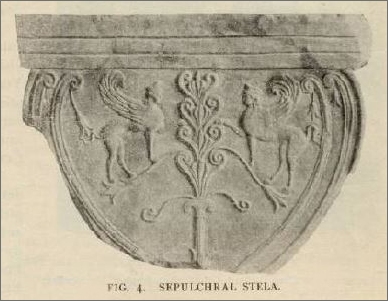
“Fig. 4. Sepulchral Stela” |
 |
 |
“Sketch by Frank T. Robinson” |
“Fig 3. Mir or Winged Disk” |
- Memorials in Georgia Marble – Eclipse Designs & Price List, Georgia Marble Company, Tate, Georgia – circa 1920.
- Memorials: To-Day, For: To-Morrow, by William Henry Deacy, The Georgia Marble Company, Tate, Georgia, 1928, produced by Thomsen-Ellis Company, Baltimore, New York.
- The Memory Stone 1768-1926, Vermont Marble Company, Proctor, Vermont. America’s Oldest Monumental Product.
- “Metal Monuments of Greenwood Cemetery,” by Mark Culver. (Includes historical information on metal monuments.)
- Michaels Bronze Tablets Catalog, The Michaels Art Bronze Co., Inc., Covington, Kentucky, Since 1870. (No date of publication, but the latest date shown is 1932.)
 |
 |
 |
Front cover of “Memorials in Georgia Marble – Eclipse Designs” Georgia Marble Company, Tate, Georgia – circa 1920 |
Title page from “Memorials in Georgia Marble – Eclipse Designs” Georgia Marble Company, Tate, Georgia – circa 1920 |
The John C. Foley (1874-1917) cemetery monument – one of the many monuments in “Memorials in Georgia Marble – Eclipse Designs” Georgia Marble Company, Tate, Georgia – circa 1920 |
 |
 |
 |
Front cover of “The Memory Stone 1768-1926,” Vermont Marble Co., Proctor, Vermont |
“Ancient Marble Work - Photographs which show some of the oldest monuments as they look today.” |
“The Kenan Mausoleum, Wilmington, North Carolina. Vermont marble” |
 |
 |
 |
Front cover of the Michaels Bronze Tablets Catalog (circa 1932) |
No. 454 Bronze Plaque |
The Standard Tablet Letter Patterns Chart |
-
“Nick Miller (1846 – 1898),” by Abby Burnett, Encyclopedia of Arkansas History & Culture, updated 2009
- “Nick Miller: Tombstone Carver Lies in Unmarked Grave,” by Abby Burnett, The Ozarks Mountaineer 57 (March/April 2009): 52-55.
- The Millstone Industry: A summary of research on quarries and producers in the United States, Europe and elsewhere, by Charles D. Hockensmith, McFarland, Jun 7, 2009, 269 pp. (Portions of this book are available on Google eBook by clicking on “view sample.”) (Chapters in this book include: Early American Millstone Documents, Millstone Quarrying in the United States, Millstone Makers and Urban Factories, The Rise and Fall of the American Millstone Industry Producers Annual Values and Decline, Foreign Millstones Imported to America, The Millstone Quarrying Industry Outside the United States, Artificial Millstones, Tools Used in Making and Sharpening Millstones, Working Conditions and Hazards in the Millstone Industry, and Conclusion.)
(Description from Google Books) “Since prehistoric times, the process of cutting rock to make millstones has been one of the most important industries in the world. The earliest rotary millstones, known as querns, were turned by human power. Later, larger millstones were manufactured that required animal, water, or wind power to turn them. These larger millstones required less human effort and ground greater quantities of grain, but also required regular maintenance and replacement. As a result, millstone quarries increased greatly in number and size in the late 19th and early 20th centuries, with the largest quarry sites extending as far as nearly a half-mile square to about 12 square miles. The first part of this book compiles information on the millstone industry in the United States, which dates between the mid-1600s and the mid-1900s. Primarily based on archival research and brief accounts published in geological and historical volumes, it focuses on conglomerate, granite, flint, quartzite, gneiss, and sandstone quarries in different regions and states. The second part focuses on the millstone quarrying industry in Europe and other areas. Of the European millstone industry, the quarries of France, Germany, and Great Britain are most extensively documented, although the quarries of Albania, Austria, the Czech Republic, Greece, Hungary, Italy, Luxembourg, Norway, Slovenia, Spain, Sweden, and Switzerland are also covered. The extensive bibliography provides scholars with many sources for future research. The book includes 84 photographs, 16 tables, and a helpful glossary of specialized and technical terms.”
- The Modern Cemetery AKA Park and Cemetery and Landscape Gardening, published by R. J. Haight, Publisher, Chicago, Illinois. (Available on Google Books)
- Modern Memorial Art Memorial Catalog, Some Examples Cut in Stony Creek, Milford Pink and Victoria White Granites (pdf), The Dodds Granite Company, Main Office: Milford, Massachusetts, Quarries & Plants: Milford, Massachusetts; Stony Creek, Connecticut; Keene, New Hampshire, New York City Office.

- Modern Memorials in Marble, Illustrating designs for various monumental purposes with numerous examples of the use of marble in both ancient and modern times, Vermont Marble Company, Proctor, Vermont, designed, engraved, and printed in Bartlett Orr Press, New York, 1922. (Includes price list for this 1922 monument catalog/book)
- Montgomery Ward & Co. Monuments, Tombstones and Markers Catalog, 1929 (in pdf), presented on this Stone Quarries and Beyond web site.
- The Monument and Cemetery Review (magazine) (pdf; 15+ MB): The Exponent of Art in the Monument Field, October, 1926, Vol. XII, No. 2.
- The Monumental Bronze Co., Bridgeport, Connecticut, Catalog B (pdf), presented by the Association for Gravestone Studies.
- “The Monumental Cemetery of Milan” Italy, in The Monumental News, Vol. 7, #11, November 1895, pp. 680-682.
-
“Monumental Design and Memorial Art,” Part XIII, Granite, Marble & Bronze, Vol. XXVII, No. 7, July 1917, pp. 22-26.
The article begins: “In the ‘Better Headstone Number’ of ‘Granite Marble & Bronze’ (issue of November, 1916) some general considerations concerning the headstone were given. These should, to take the proper place in this series, appear here. Architectural details – mouldings, the column, the arch, etc. – have been discussed, followed by the articles on lettering and ornament. These matters, which more or less concern all memorials, having been disposed of the different types of funerary monuments can finally be discussed in detail….”
- Monumental Estimates in Granite, compiled by the Victory Granite Company, Sauk Rapids, Minnesota, 1946.
-
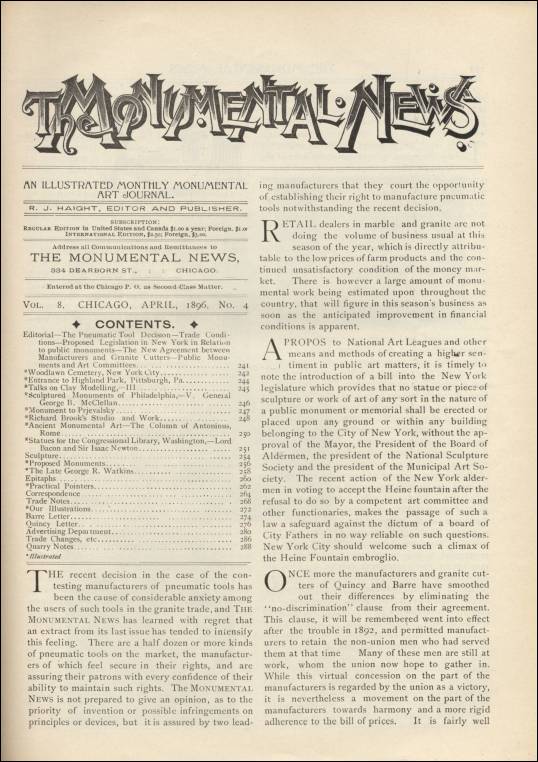
Monumental Magazines Available Online (American Stone Trade; Granite / Granite, Marble, & Bronze; The Modern Cemetery AKA Park and Cemetery and Landscape Gardening; The Reporter, Devoted to the Granite and Marble Monumental Trade; Stone: An Illustrated Magazine; The Stone Cutter's Journal; etc.)
- The Monumental News Magazine: An Illustrated Monthly
Monumental Art Journal, Chicago, Illinois.
- 1892 – The Monumental News Magazine – An index of the 1892 issues of The Monumental News is available. The
following 1892 issues of The Monumental
News magazines are available in PDF format: January
1892, Vol. 4, No. 1 (January Index) — February
1892, Vol. 4, No. 2 (February Index) — March
1892, Vol. 4, No. 3 (March Index) — April
1892, Vol. 4, No.
4 (April Index) — May
1892, Vol. 4, No. 5 (May Index) — June
1892, Vol. 4, No.
6 (June Index) — July
1892, Vol. 4, No. 7 (July Index) — August
1892, Vol. 4,
No. 8 (August Index) — September
1892, Vol. 4, No. 9 (September Index) — October
1892,
Vol. 4, No. 10 (October Index) — November
1892, Vol. 4, No. 11 (November Index) — December
1892, Vol. 4, No. 12 (December Index). (The preceding PDF files
are all about 7+ MB.)
The following thumbnail images are of the “Content” pages for each individual issue for 1892 of The Monumental News Magazine. (Click on the links in the paragraph above to access the full issues in PDF. Peggy B. Perazzo)

Jan. 1892

Feb. 1892

Mar. 1892

Apr. 1892

May 1892

June 1892

July 1892

Aug. 1892

Sep. 1892

Oct. 1892

Nov. 1892

Dec. 1892
- 1893 – The Monumental News Magazine – The
following 1893 issues of the of The
Monumental News magazines are available in PDF format:
January
1893, Vol. 5, No. 1 — February
1893, Vol. 5, No. 2 — March
1893, Vol. 6 (5), No. 3 — April
1893, Vol. 6 (5), No.
4 — May
1893, Vol. 6 (5), No. 5 — June
1893, Vol. 6 (5), No.
6 — July
1893, Vol. 5, No. 7 — August
1893, Vol. 5,
No. 8 — September
1893, Vol. 5, No. 9 — October
1893,
Vol. 5, No. 10 — November
1893, Vol. 5, No. 11 — December
1893, Vol. 5, No. 12. (The preceding files are
from 8 to 9+ MB. Please note that the volume numbers for the above
issues start at Vol. 5, change to Vol. 6 for 4 issues, and then
go back to Vol. 5.)
The following thumbnail images are of the “Content” pages for each individual issue for 1893 of The Monumental News Magazine. (Click on the links in the paragraph above to access the full issues in PDF. Peggy B. Perazzo)

Jan. 1893

Feb. 1893

Mar. 1893

Apr. 1893

May 1893

June 1893

July 1893

Aug. 1893

Sep. 1893

Oct. 1893

Nov. 1893

Dec. 1893
-

Jan. 18941894 – The Monumental News Magazine: An Illustrated Monthly Monumental Art Journal – The following 1894 issues of The Monumental News magazines are available in PDF format: January 1894, Vol. 6, No. 1 — February 1894, Vol. 6, No. 2 — March 1894, Vol. 6, No. 3 — April 1894, Vol. 6, No. 4 — May 1894, Vol. 6, No. 5 — June 1894, Vol. 6, No. 6 — July 1894, Vol. 6, No. 7 — August 1894, Vol. 6, No. 8 — September 1894, Vol. 6, No. 9 — October 1894, Vol. 6, No. 10 — November 1894, Vol. 6, No. 11 — and December 1894, Vol. 6, No. 12. (The preceding files are about 11 MB or less. Only the January issue contains a “Contents” section.) - 1895 – The Monumental News Magazine:
An Illustrated Monthly Monumental Art Journal – The
following 1895 issues
of The Monumental News magazines are available in PDF format: January
1895, Vol. 7, No. 1 — February
1895, Vol. 7, No. 2 — March
1895, Vol. 7, No. 3 — April
1895, Vol. 7, No. 4 — May
1895, Vol. 7, No. 5 — June
1895, Vol. 7, No. 6 — July
1895, Vol. 7, No. 7 — August
1895, Vol. 7, No. 8 — September
1895, Vol. 7, No. 9 — October
1895, Vol. 7, No. 10 — November
1895, Vol. 7, No. 11 — and December
1895, Vol. 7, No. 12. (The
preceding files are about 19 MB or less.)
The following thumbnail images are of the “Content” pages for each individual issue for 1895 of The Monumental News Magazine. Only the issues for January & April through December contain a “Contents” section.(Click on the links in the paragraph above to access the full issues in PDF. Peggy B. Perazzo)

Jan. 1895

Apr.
1895
May 1895

June 1895

July 1895

Aug. 1895

Sep. 1895

Oct. 1895

Nov. 1895

Dec. 1895
- 1896 – The Monumental News Magazine:
An Illustrated Monthly Monumental Art Journal – The
following 1896 issues of The Monumental News magazines
are available in PDF format: January
1896, Vol. 8, No. 1 (18+ MB) — February
1896, Vol. 8, No. 2 (12+ MB) — March
1896, Vol. 8, No. 3 (12+ MB) — April
1896, Vol. 8, No. 4 (11+ MB) — May
1896, Vol. 8, No. 5 (12+ MB) — June
1896, Vol. 8, No. 6 (12+ MB) — July
1896, Vol. 8, No. 7 (12+ MB) — August
1896, Vol. 8, No. 8 (12+ MB) — September
1896, Vol. 8, No. 9 (11+ MB) — October
1896, Vol. 8, No. 10 (12+
MB) — November
1896, Vol. 8, No. 11 (11+
MB) — December
1896, Vol. 8, No. 12 (11+ MB).
The following thumbnail images are of the “Content” pages for each individual issue for 1896 of The Monumental News Magazine. (Click on the links in the paragraph above to access the full issues in PDF.)

Jan. 1896

Feb. 1896

Mar. 1896

Apr. 1896

May 1896

June 1896

July 1896

Aug. 1896

Sept. 1896

Oct. 1896

Nov. 1896

Dec. 1896
- The Monumental News, Vol. 2, January - December 1897, presented on the hathitrust.org web site, digitized by Google, or on the Google Books web site.
- The Monumental News, Vol. 2, 1899, presented on the hathitrust.org web site, digitized by Google, or on the Google Books web site.
- The Monumental News, Vol. 12, 1900, presented on the hathitrust.org web site, digitized by Google.
- The Monumental News, Vol. 13, 1901, presented on the hathitrust.org web site, digitized by Google, or on the Google Books web site.
- The Monumental News, Vol. 14, 1902, presented on the hathitrust.org web site, digitized by Google, or on the Google Books web site.
- The Monumental News, Vol. 16, 1904, presented on the hathitrust.org web site, digitized by Google, or on the Google Books web site.
- 1892 – The Monumental News Magazine – An index of the 1892 issues of The Monumental News is available. The
following 1892 issues of The Monumental
News magazines are available in PDF format: January
1892, Vol. 4, No. 1 (January Index) — February
1892, Vol. 4, No. 2 (February Index) — March
1892, Vol. 4, No. 3 (March Index) — April
1892, Vol. 4, No.
4 (April Index) — May
1892, Vol. 4, No. 5 (May Index) — June
1892, Vol. 4, No.
6 (June Index) — July
1892, Vol. 4, No. 7 (July Index) — August
1892, Vol. 4,
No. 8 (August Index) — September
1892, Vol. 4, No. 9 (September Index) — October
1892,
Vol. 4, No. 10 (October Index) — November
1892, Vol. 4, No. 11 (November Index) — December
1892, Vol. 4, No. 12 (December Index). (The preceding PDF files
are all about 7+ MB.)
- Monument Trade Builder, March-April, 1918, published by Barclay Brothers, Barre, Vermont, 16 pp. (regarding monument construction and production)

 |
 |
 |
Front cover of Modern Memorials in Marble, Vermont Marble Company, 1922 |
Campo Santo at Genoa, Italy – one of the largest and finest cemeteries in Italy, pp. 34 in Modern Memorials in Marble, Vermont Marble Co., 1922 |
The Hote Memorial, pp. 65 of Modern Memorials in Marble, Vermont Marble Co., 1922 |
 |
 |
“Entrance to Monumental Cemetery, Milan, Italy,” in "The Monumental News," Nov. 1895 |
“View in Monumental Cemetery, Milan” Italy, in "The Monumental News," Nov. 1895 |
 |
 |
“From a monument in Monumental Cemetery, Milan” Italy, in "The Monumental News," Nov. 1895 |
“Monument in the Monumental Cemetery, Milan” Italy, in "The Monumental News," Nov. 1895 |
 |
 |
“Colonial headstone, Granary Burying Ground, Boston, Mass. (Photo by Frank Cousins Art Co.)” |
“Colonial headstone, Granary Burying Ground, Boston, Mass. (Photo by Frank Cousins Art Co.)” |
 |
 |
 |
Front & back covers of the booklet, "Monumental Estimates in Granite," by the Victory Granite Co. of Sauk Rapids, Minnesota |
pp. 78 in the booklet, "Monumental Estimates in Granite," showing concave-, convex-, serpentine-style monument size and prices |
pp. 80 & 81 in the booklet, "Monumental Estimates in Granite," showing crosses, and sandblast letters, raised letters, carving dies, & Carving Wedge and Hickey Marker sizes and prices |




 |
 |
 |
“A Barclay Memorial with a pleasing arrangement of the headstone. Erected in New Jersey and sold through Barclay Bros.’ New York representative, George L. Mead.” (Herman & Wilhelmina Janssen) |
“A Barclay Memorial in Illinois. Sold through Barclay Bros.’ Chicago Office, Charles H. Gall, Manager.” (Settlemire) |
“A famous Barclay memorial cut from ‘Sunnyside’ Barre granite from the ‘Standard’ quarries.” (Reynolds) |
- Monuments .. For The Ages, Miller Monuments, Incorporated, Plymouth & Elkhart, Indiana, No date of publication.
 |
 |
 |
Front cover of Monuments..For The Ages |
“Symbols and Their Meaning” section of Monuments..For The Ages |
One of the pages from Monuments.. For The Ages |
- Monuments, Memorials & Tombstones, in the “Cemeteries & Funeral Homes” section of Cyndi’s List
- Mortuary Trade Journals, presented by Jeremy W. Pye, Student of Mortuary Archeology and Funeral Behaviors.
- “Motor Truck in the Monument Business: What Retail Monument Dealers Think of the Efficiency of Motor Transportation for Memorial Work,” article in Granite Marble & Bronze, Vol. XXXI, No. 1, January 1921, pp. 32-33d, presented on this Stone Quarries and Beyond web site. (This article is also available on Stone Quarries and Beyond at at this link: “Motor Truck in the Monument Business.”)
- “My Soul From Out This Shadow Shall Be Lifted Nevermore; Nick Miller, Tombstone Carver, 1846 – 1898,” by Abby Burnett, Carroll County Historical Quarterly 53 (June 2008): 17-22.
- The New England Granite Works Catalog (pdf) Established in 1845, Chartered 1877 (no date of publication shown) 489 Fifth Avenue, New York City, New York; General Office, Westerly, Rhode Island; Quarries and Works: Westerly, Rhode Island, and Concord, New Hampshire.

- “‘No Pompous Marble To Thy Name We Raise’: A.H. Morley and Family, Fayetteville Tombstone Carvers,” by Abby Burnett, Flashback, Journal of the Washington County Historical Society 58 (Fall 2008): 115-145.
- Northern Illinois Granite Co., Makers of Monuments of Quality, Kankakee, Illinois, Advertising Service of Bliss Design Co., Rockford, Ill. (No date of publication)
- O. M. Burrus & Bros. Inc., Monumental Catalog, Burlington, Iowa. (There is no date for this publication, although O. M. Burrus & Bros. Inc. (R. R. Burrus, president, and R. K. Burrus, secretary) were listed in the Iowa State Gazetteer and Business Directory 1918-1919, published by R. L. Polk & Co., as located on 831 Jefferson Street.)
- “Oakwood Cemetery, Syracuse, New York,” in The Monumental News, February 1896, pp. 126-127.
- Oglesby Blue Granite Mausoleum Catalog, Elberton, Georgia, 1937 (pdf)
- Old City Cemetery web site where you can purchase Leeanna Rossi’s booklet: Headstones of the Gold Rush Era: Sculpting Masterpieces in Marble, Golden Notes Vol. 43, No. 3, Fall 1997, Sacramento County Historical Society. (This book is available at the Old City Cemetery in Sacramento web site. If you would like to call and order a copy, their address and phone number is: Old City Cemetery Committee, Inc., 1000 Broadway, Sacramento, CA 95818, (916) 448-0811.
- Outlines of Historic Ornament, Translated from the Germany, Edited by Gilbert R. Redgrave, London: Chapman and Hall, 1884, 170 pp. (Section I. “Elementary Ornament” Northern and Central Europe & Northern and Central America; Section II. “Pre-Christian Ornament” The Egyptian Style, The Assyrio-Persian Style, The Indo-Chinese Style, The Greek Style, The Etruscan Style, and The Roman Style; Section III. “Early Christian Ornament” The Romano-Christian Style, The Byzantine Style; Section IV. “Mohammedan Ornament” The Arabian Style and The Arabian Style in Spain, Sicily, Egypt, Persia, India, and Turkey; Section V. “Medieval Ornament” The Romanesque Style, The Romanesque Style in Italy, France, England, Ireland, Germany, and Austria; The Gothic Style, The Gothic Style in France, the Netherlands, England, Germany, and Italy; Section VI. “Modern Ornament” The Style of the Renaissance and Baroque and Rococo Style.) (This book is available for reading on the Internet Archive web site.)
- Park and Cemetery and Landscape Gardening Magazine (AKA The Modern Cemetery), published by R. J. Haight, Publisher, Chicago, Illinois. (Available on Google Books)
- Penryn, Placer County, Granite Quarry Photographic Tour.
- Personality In Memorials, Marker Catalog No. 106, Comolli Granite Co., Elberton, Georgia (no date of publication)

 |
 |
 |
Front cover of Northern Illinois Granite Co., Makers of Monuments of Quality, Kankakee, Illinois |
One of the monuments displayed in the booklet, Northern Illinois Granite Co., Makers of Monuments of Quality, Kankakee, Illinois |
One of the monuments displayed in the booklet, Northern Illinois Granite Co., Makers of Monuments of Quality, Kankakee, Illinois |
 |
 |
 |
Front cover of O. M. Burrus & Bros. Inc., Monumental Catalog, Burlington, Iowa |
“Section of Wareroom Showing Finished and Partly Finished Work.” (From O. M. Burrus & Bros. Inc., Monumental Catalog, Burlington, Iowa) |
“Note Here Our New Designs of Cross Monuments….” (From O. M. Burrus & Bros. Inc., Monumental Catalog, Burlington, Iowa) |
 |
 |
 |
“Oakwood Chapel,” Oakwood Cemetery, Syracuse, New York (“The Monumental News,” Feb. 1896) |
“View in Neighborhood of Chapel” Oakwood Cemetery, Syracuse, New York (“The Monumental News,” Feb. 1896) |
“Dedication Valley” Oakwood Cemetery, Syracuse, New York (“The Monumental News,” Feb. 1896) |
 |
 |
 |
Front page of Personality in Memorials, Marker Catalog No. 106, Comolli Granite Co., Elberton, Georgia |
Page 2 of Personality |
Page 17 of Personality |
- A Plant and Its Product, Drew Daniels Granite Company, Wholesale Manufacturers, Waterbury, Vermont (circa 1910)

Front cover of A Plant and Its Product, published by the Drew Daniels Granite Co., Waterbury, Vermont ( circa 1910)
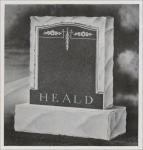
The Heald cemetery memorial design in A Plant and Its Product, published by the Drew Daniels Granite Co., Waterbury, Vt.
( circa 1910) - “Pneumatic Tools: Inventors,” by Mary Bellis, About.com Guide.
- A Portfolio of Architectural Memorial Designs brochure (pdf), presented by Kenerson Design Studio, Barre, Vermont, no date of publication. (This brochure displays cemetery monuments.)


 |
 |
 |
Front cover of A Portfolio of Architectural Memorial Designs |
One of the pages in the brochure displaying cemetery monuments by Kenerson Design Studio |
Back page of the brochure displaying cemetery monuments by Kenerson Design Studio |
-
“Principles of Greek Memorial Art,” A Review of ‘The Principles of Greek Art,’ by Percy Gardner, Litt. D., Published by The Mcmillan Company, New York,” The Monumental News, Vol. XXIX, No. 5, May 1917, pp. 278-279.
The article begins:
“The message of Greek art exercises a wide influence in the field of American stone-craft – perhaps to a greater extent than is true of any other branch of applied art. The fine simplicity, purity and regularity of Grecian architecture and its ornamentation, makes a strong appeal to the American, and the growing demand for fine lines and architectural simplicity in our Memorials encourages the designer to improve his understanding of the character and development of Greek art….”
- Producers’ Marble Company’s Illustrated Catalogs of 1886, ’87 and ’89 – This Book Contains Eighty-four Choice Designs Selected from the Late Producers’ Marble Company’s Illustrated Catalogs of 1886, ’87 and ’89, D. H. Dickinag (?), Water Street, Chicago, Illinois, June, 1889.
 |
 |
 |
“Sloping lines of basis of Parthenon” (from “Principles of Greek Memorial Art,” The Monumental News, May 1917, pp. 278) |
“Anatomy of the Parthenon,” (from “Principles of Greek Memorial Art,” The Monumental News, May 1917, pp. 279) |
“Doric, Ionic and Cointhian columns,” (from “Principles of Greek Memorial Art,” The Monumental News, May 1917, pp. 279) |
 |
 |
 |
Title page of the Producers’ Marble Co. Catalogs of 1886, ’87, and ’89 (Vermont) |
One of the cemetery stones in the Producers’ Marble Co. Catalogs of 1886, ’87, and ’89 (Vermont) |
One of the cemetery stones in the Producers’ Marble Co. Catalogs of 1886, ’87, and ’89 (Vermont) |
- Products
of Tompkins-Kiel Marble Company Stone Catalog, Distributors of Marble – Stone, New
York, circa 1890’s through 1915, 90 pp.

Products of Tompkins-Kiel Marble Company Stone Catalog, circa 1915
- “The Progress of the Monumental Business in a Century,” in The Monumental News, October 1894.
- “Quarry,” (definition, description, and photographs) on Wikipedia.
- Raymond / Knowles Granite – Photographic tour of the area and some of its quarries.
- “Reflections of Change: Death and Cemeteries in the Boonslick Region of Missouri,” Maryellen Harshbarger McVicker. (This book is no longer available at the link below, but you can access the book using the Internet Archive Wayback Machine link above.)
<http://www.mo-river.net/history/boonslick/> - The Reporter, Devoted to the Granite and Marble Monumental Trade (Magazine), published by Nichols & Co., Chicago, Illinois. (Available on Google Books)
- Reservation…for the last long rest!, mausoleum catalog, by Cold Spring Granite Company, Cold Spring, Minnesota (no date of publication)
- Retail Dealers Guide: A Reference Book for Placing Orders for Monumental Work and Rough Stock 1914 (1915, 1916, 1917, & 1918), A. M. Hunt Co., Boston, Mass. (Vols. 7-11 in file: 1914, 1915, 1916, 1917, & 1918 are available in one file on Google Books)
- “The Retail Monument Dealer and His Work” Fine types of memorials erected in our cemeteries. What the retail monument dealer is doing in the way of better work, Granite Marble & Bronze, Vol. XXVII, No. 12, December 1917, pp. 31-34.
- Rock-Faced Monuments: Illustrations and Descriptions of Some of the Best Examples of Rock-Faced Memorials, Edited and Arranged by Harry A. Bliss, Publisher, Press of the Monument and Cemetery Review, Buffalo, New York, 1919. (Excerpt from the Forward: “This book, Rock-Faced Monuments, is published with the purpose of supplying to the granite industry a practical volume illustrating some of the best work in rock-faced memorials. It Is designed especially as a book of suggestions and comparative illustrations for monument dealers, designers and salesmen, but the illustrations are also of general interest….”)

 |
 |
 |
Front cover of Reservation…for the last long rest!, mausoleum catalog, by Cold Spring Granite Company, Cold Spring, Minnesota |
Granite works of the Cold Spring Granite Co. from Reservation…for the last long rest!, mausoleum catalog, by Cold Spring Granite Company, Cold Spring, Minnesota |
One of the many mausoleum sketches from Reservation…for the last long rest!, mausoleum catalog, by Cold Spring Granite Company, Cold Spring, Minnesota |
(photo captions) “This memorial of grace and beauty is the work of the Tayntor Granite Co., New York City.” “This Snader memorial is the work of the Edward A. Carroll Co., Philadelphia, PA.” “Detail of carving on the Seabury monument, which was recently erected by the Tayntor Granite Co., New York City.” “Memorial of classic style, erected by the Hinman-Boynton Granite Co., Syracuse, N. Y.” “Crosses designed and erected by the Detwiler’s Marble Works, Phoenixville, PA.” “Memorial designed and erected by the Rosebrough Monument Co., St. Louis, Missouri.” “Monument of good proportions erected by W. Y. Haldy & Sons, Lancaster, PA.” “Interesting memorial erected by George A. Detwiler, Detwiler’s Marble Works, Phownixville, Pennslvania.”“Cross erected by the Sears Monument Co., Charleston, West Virginia.” “Monument designed and erected by C. Rogers Smith, Middletown, New York.” “Mausoleum of refined detail designed and erected by Edward A. Carroll Co., Philadelphia, Pennsylvania.” “The Hinman-Boynton Granite Co., Syracuse, New York., designed and erected this interesting memorial of sarcophagus type.”
- Rocklin, Placer County, Granite Quarry Photographic Tour.
- “‘San Francisco Pioneer Cemeteries’: Where the Dead Live,” San Francisco Chronicle online edition, by Regan McMahon, Thursday, October 29, 2009.
- Santa Cruz County Marble Quarries – Photographic Tours (4 listed at the end of the menu)
- “Sculptors, Monument Companies, and Iron Works,” compiled by Leeanna Rossi.
- Sears, Roebuck & Co. – “History of the Sears Catalog” section of the Sears Archives web site.
- “Sheet Metal Statuary,” in The Monumental News, Jan. 1896, pp. 62-63. This article begins: “As may be recognized by the accompanying illustration…sheet metal statuary is becoming a prominent feature in decorative work. It is light, the methods employed in its construction are such that the model may be faithfully reproduced, and its strength and durability, are important factors in its adoption for such situations as it merits may suggest. The well known firm of W. H. Mullins, of Salem, Ohio, has built up a large business in this class of work….”
- “Slate,” on Wikipedia. (Includes photographs of slate cemetery stones.)
-
“Some Decoration Day Observations: A Consideration of Memorial Art as Exhibited in a Few Designs of Memorials Erected This Spring,” by L. A. Whitehouse, from Granite Marble & Bronze, February 1917, pp. 31-35.
(The article beings) “Before the close of the Civil War the 30th of May was observed as a holiday in several of the Southern states for the purpose of decorating with flags and flowers the graves of soldiers killed in the war. In the North there was no fixed day commonly celebrated until on May 5th, 1868, when Commander-in-Chief John A. Logan of the Grand Army of the Republic issued a general order designating the date ‘for the purpose of strewing with flowers and otherwise decorating the graves of comrades who died in defense of their country during the late rebellion…In 1882 the Grand Army urged that the ‘proper designation of May 30 is Memorial Day’ – not Decoration Day. However, no matter which way one may designate it, the day plays a big part in the pans of the monument man, and it is previous to this day, each year, that he erects many of his most highly prized achievements – the work to which he points for proof of his fitness to serve.
“Among the photographs of such work which have been brought to the attention of the writer that deserve special comment are many examples of good design and workmanship, as evidenced by the accompanying illustrations….”
- “Some Examples of Recent Mausoleum Work,” in The Monumental News, Vol. XXXIII, No. 1, January 1921, pp. 44-46.
- Some Stone Carvers & Monument Companies That Produced the Yolo County Stones in the Late 1800’s to early 1900’s (Brochure by Peggy B. Perazzo in pdf)
- Sources of Memorial Ornamentation (pdf), by Henry Powell Hopkins, A.M., B.Arch., A.I.A., Vermont Marble Company, Proctor, Vermont, printed by the Barta Press, Cambridge, Mass., 1924, 44 pp., presented on this Stone Quarries and Beyond web site.
-
“Stained Glass in Monumental Work,” in The Monumental News, February 1896, pp. 118-119.

“Window in Chapin Memorial Chapel, Hope Cemetery, Springfield, Mass.” (The Monumental News, February 1896, pp. 118)
- Sterling Granite Company Monumental Catalog – Book 12, Elberton, Georgia, No date of publication printed in booklet, possibly late 1930s.
- Stone: An Illustrated Magazine, published by the D. H. Ranck Publishing Co., Indianapolis, Indiana. (Many issues of this old magazine from 1888 through (eventually) 1922 are available on Google Books in their Full View Books in which you can view images of the pages. You can find a list and links to the books in the list of all editions of Stone magazine listed on Google Books.)
- The Stone Cutters’ Journal Magazine, Journeymen Stone Cutters’ Association of North America, Issued monthly at Indianapolis, Indiana. Organized 1855. Affiliated with the American Federation of Labor, Building Trades Department, Division Trades of Congress. (Available on Google Books.)
- The Stone Industries: Dimension Stone, Crushed Stone, Geology, Technology, Distribution, Utilization, by Oliver Bowles, Supervising Engineer, Building Materials Section, United States Bureau of Mines, 2nd ed., New York & London: McGraw-Hill Book Co., Inc., 1939. (This book is available on the Internet Archive.)
- Stories in Stone: A Field Guide To Cemetery Symbolism and Iconography, by Douglas Keister, Photographs by Douglas Keister, Gibbs Smith, 2004ISBN158685321X, 9781586853211288 (Book).
- The Structural and Industrial Materials of California, Lewis E. Aubury, State Mineralogist, California State Mining Bureau, San Francisco, 1906. (Available on Google Books.)
- Symbols of Service Monumental Catalog & Price List, Vermont Marble Co., Proctor, Vermont, 1919. (A few of the images from the booklet are shown below.)
 |
 |
 |
Front cover of Rock-Faced Monuments, 1919 |
One of the monuments presented in Rock-Faced Monuments, 1919 |
Another monument presented in Rock-Faced Monuments, 1919 |
 |
“View of sheet metal statuary at W. H. Mullins Establishment, Salem, O.” (The Monumental News, January 1896, pp. 63) |
 |
 |
 |
The Ainsworth monument was “Erected by F. D. Black, Grand Rapids, Mich.” |
The Arthur A. End monument was “Erected by Stolzer Granite Co., Milwaukee, Wisconsin.” |
The Carl Manthey monument was “Erected this spring (1917) by Carl Manthey & Sons Co., Green Bay, Wisconsin. It is interesting to note that Carl Manthey has erected this monument as his own private memorial.” |
 |
 |
 |
“Cone Mausoleum, Greensboro, North Carolina, McDonnell & Sons, Buffalo, New York, Contractors.” |
“Presbrey-Leland Company, Contractors.” (The Manville Mausoleum is located in the Kensico Cemetery, New York....”) |
“Charles G. Blake & Company, Contractors.” (“One of the finest mausoleums erected in Chicago (in the Graceland Cemetery in Illinois) in recent years is the ‘Lehmann’ mausoleum....”) |
 |
 |
“Gall & Company, Contractors.” (“The J. K. Stewart mausoleum recently completed in Graceland Cemetery, Chicago….” (ca. 1921) |
“P. N. Peterson Granite Company, Contractors.” (“…The ‘Wood’ mausoleum…was erected by the P. N. Peterson Granite Co., in Lakewood Cemetery, Minneapolis....”) |

 |
 |
 |
Front cover of the Sterling Granite Company Monumental Catalog |
“Have your monumental work come from granite that is quarried out of the heart of this fine (Sterling Granite Co.) quarry.” |
“In Sterling-Blue and Genuine Sunset-Pink Granite Monuments you are assured of workmanship produced by highly skilled craftsmen of long experience.” |
 |
 |
 |
“Have your monument polished and be sure of this fine lasting finish so well adapted to Sterling-Blue and Genuine Sunset-Pink Granites”
|
“‘Loveland’ Design No. 511,” with the Laurel leaf carving, symbolic of Reward and Victory. |
“‘Brockel’ Design No. 503,” with an “…artistic treatment of the Cross and Rose Vine carving, with a religious Significance symbolic of Faith, Atonement, Our Lord and the Church”
|
 |
 |
 |
Front cover of Symbols of Service, one of the monumental catalogs by the Vermont Marble Co., Prctor, Vermont |
“Grouped on this page are some of the more important emblems of the American Army.” |
Front page of the “Price List of the ‘Symbols of Service’ Designs” (Vermont Marble Co., 1919) |
- “Teaching with Tombstones: Geology at the Cemetery,” (pdf) by Joseph T. Hannibal, 2007, in N. R. Shaffer and D. A. DeChurch, eds., Proceedings of the 40th Forum on the Geology of Industrial Minerals, May 2-7, 2004, Bloomington, Indiana: Indiana Geological Survey Occasional Paper 67, pp. 82-88.
- “Timeline of Transportation Technology,” on Wikipedia.
- “Tomb,” on Wikipedia. (Photographs of tombs are presented along with historical references.)
- “Tombstone Carvers of Newton County” (Arkansas), by Abby Burnett, The Newton County Homestead, Journal of the Newton County Historical Society (2009): 8-11.
- “Tombstone Epitaphs, The,” on Wikipedia.
- “Tombstone (Manufacturing),” on Wikipedia.
- Tombstones and Monuments: Catalog of Memorial Art in Granite and Marble, Sears, Roebuck & Co., Chicago, Illinois, First Edition, circa 1906 (large file)
 |
 |
 |
Front cover of “Tombstones and Monuments: Catalog of Memorial Art in Granite and Marble,” Sears, Roebuck & Co., Chicago, Illinois, First Edition, circa 1906 |
Title page of “Tombstones and Monuments,” Sears, Roebuck & Co., Chicago, Illinois, First Edition, circa 1906 |
The “Grave Lot Enclosures” section of “Tombstones and Monuments,” Sears, Roebuck & Co., Chicago, Illinois, First Edition, circa 1906 |
 |
 |
 |
|
Three of the monuments in “Tombstones and Monuments,” Sears, Roebuck & Co., Chicago, Illinois, First Edition, circa 1906 |
|
- Tombstones, and the Men Who Created Them, presentation by Mary-ellen Jones, Nov. 26, 1996, from the Contra Costa County Genealogical Society newsletter.
- A Tract Upon Tomb-Stones; Or, Suggestions for the Consideration of Persons Intending To Set Up That Kind of Monument to the Memory of Deceased Friends, by Francis Edward Paget, 3rd ed., J. Masters, Publisher, 1853, 23 pp. (Available on Google Full View Books)
- “Types of Cemetery Markers,” article by Marie Louise, presented on ehow.com.
- “Types of Cemetery Stones,” article by Dawn Fenske, presented on ehow.com.
- “Types of the Year’s Best Cemetery Monuments (pdf) (1921) Many Distinctive Types: Development of Tablet and Cross Forms, in The Monumental News, Vol. XXXIII, No. 1, January 1921, pp. 21-31.
- Universal Monument Company, Atlanta, Georgia
- Lasting Memorials of Artistic Beauty, Design Book No. 108 (pdf), Universal Monument Company, Atlanta, Georgia, 1920’s. (Note, this is a large document.)
- Monuments of Enduring Beauty (pdf), Universal Monument Company, Atlanta, Georgia, 1920s.
- Price List of Marble and Granite Monuments in Design Book No. 108 (pdf), Universal Monument Company, Atlanta, Georgia, 1920s.
- “Various Aspects of the San Francisco Disaster (Earthquake)” in the Monumental News Magazine, August 1906, on Stone Quarries and Beyond web site.
- Vermont Marble Company Dealer’s Sales Portfolio: Information on Designs and Other Illustrations (pdf), October 1940. Below are a few of the photographs included in this dealer’s sales portfolio binder, which is available at the link above. Peggy B. Perazzo
 |
 |
 |
Wilson Memorial, Evergreen Cemetery, Colorado Springs, Colo. For the first city manager of Colorado Spring.
|
Pillars Memorial, Garden of Memory, Fostoria, Ohio |
Old Vermont Marble Headstones |
- Vermont Marble Company Producers and Finishers of Sutherland Falls and Rutland White and Blue Marble, 1882 Price List and Key for the Trade Only. Vermont Marble Company (Successor to the Sutherland Falls and Rutland Marble Companies).
- Vermont Marble Company Price List of Monumental Marble, Effective September 1, 1946, Price List for Design Book No. 21, Vermont Marble Company, Proctor, Vermont.
- Vermont Marble Company Whole Sale Price List of Monumental Marble, Effective January 3, 1950, Vermont Marble Company, Proctor, Vermont (Branches: Chicago – 1105 West Lawrence Avenue; Cleveland – 1737 Euclid Avenue; Dallas – 1513 Wall Street; New York – 101 Park Avenue; Philadelphia – 1524 Chestnut Street; San Francisco – 525 Market Street)
- A Visit to the Slate Quarries of Angers (France), Scientific American - Supplement No. 974, Munn & Co., New York, 1894, on the Stone Quarries & Beyond web site.
- W. A. Hambleton Granite Monuments & Statuary Catalog – At Wholesale, Book No. 10 (pdf), American & Foreign, Mansfield, Ohio; Barre, Vermont; Aberdeen, Scotland.
- “Warping Marble in New Orleans and Other Cemeteries: A Review,” by Joseph T. Hannibal, in Z. Lasemi, ed., Proceedings of the 47th Forum on the Geology of Industrial Minerals: Illinois State Geological Survey, Circular 587, 2015.
Abstract: “Erhard Winkler noted the warping of marble tablets in the cemeteries of New Orleans in various editions of his classic work Stone: Properties, Durability in Man’s Environment, and others in the United States and Europe have noted and commented on the striking marble deformation seen in these and other cemeteries. This paper briefly reviews marble warping in New Orleans cemeteries and puts these observations into a larger context of marble warping in cemeteries in general (which is not rare but is generally not well documented) and into that of marble cladding used for buildings (which is well known and has become increasing well documented). This study also brings together disparate sources that discuss, note, or illustrate marble warping, particularly that in cemeteries.”
- “White Bronze Monuments,” by Barbara Rotundo, on the Association For Gravestone Studies web site.
- “H. J. Wiebusch, Batesville, Arkansas: A Nineteenth Century Stonecarver,” by Roberta D. Brown, Arkansas Historical Quarterly 42 (Autumn 1983): 197-206.
- Woodmen of the World Grave Markers
- Yolo County Cemeteries on the Yolo County CAGenWeb Project web site.
- Yolo County Cemeteries: Past & Present, presented on the Yolo County CAGenWeb Project web site.
- Yolo County Stone Industry, etc., on the Stone Quarries & Beyond web site.
- Yolo
County Stone Industry, etc., section, on the
Stone Quarries & Beyond
web site.
- Yolo County Stone Quarries (The “Devils Gate” entries present photographs of the area where the quarry was once located and buildings and cemetery stones, etc., constructed of Devil’s Gate / Cache Creek / Winters Sandstone.)
- Yolo County Stone Quarries (The “Devils Gate” entries present photographs of the area where the quarry was once located and buildings and cemetery stones, etc., constructed of Devil’s Gate / Cache Creek / Winters Sandstone.
- Zinc Markers: A site dedicated to white bronze monuments.
 |
 |
 |
Front cover of Vermont Marble Company Producers and Finishers of Sutherland Falls and Rutland White and Blue Marble, 1882 Price List |
Page 4 of Vermont Marble Company Producers and Finishers of Sutherland Falls and Rutland White and Blue Marble, 1882 Price List |
Page 5 of Vermont Marble Company Producers and Finishers of Sutherland Falls and Rutland White and Blue Marble, 1882 Price List |
 |
 |
 |
Page 6 of Vermont Marble Company Producers and Finishers of Sutherland Falls and Rutland White and Blue Marble, 1882 Price List |
Page 7 of Vermont Marble Company Producers and Finishers of Sutherland Falls and Rutland White and Blue Marble, 1882 Price List |
Page 87 of Vermont Marble Company Producers and Finishers of Sutherland Falls and Rutland White and Blue Marble, 1882 Price List |
 |
 |
 |
Title page of the Vermont Marble Co. Price List of Monumental Marble, Effective Sept. 1, 1946 (Price List for Design Book #21) |
Pages 32 & 33 of the Vermont Marble Co. Price List of Monumental Marble, Effective Sept. 1, 1946 (Price List for Design Book #21) |
Pages 6 & 7 of the Vermont Marble Co. Price List of Monumental Marble, Effective Sept. 1, 1946 (Price List for Design Book #21) |
 |
 |
 |
Front cover of the Vermont Marble Co. Wholesale Price List of Monumental Marble, Effective January 1, 1950 |
Index for the Vermont Marble Co. Wholesale Price List of Monumental Marble, Effective January 1, 1950 |
Pages 2 & 3 listing the varieties of monumental marble (Vermont Gray, Pittsford Valley, & Rutland White) in the Vermont Marble Co. Wholesale Price List of Monumental Marble, Effective January 1, 1950 |
| “Figure 1. Bowed (warped) marble in cemeteries….(b) Deformed marble gravestone and other less deformed gravestones in St. Peter’s Churchyard cemetery, Philadelphia….November 2011 photographs.” (From: Hannibal, 2015 (https://www.isgs.illinois.edu/research/industrial-minerals/forum). ©2015 University of Illinois Board of Trustees. All rights reserved. For permission information, contact the Illinois State Geological Survey.) |  |
| “Figure 3. Warped closure tablets in New Orleans cemeteries….(d) S-shaped warping in Lafayette Cemetery No. 1, March 2011 photographs.” (From: Hannibal, 2015 (https://www.isgs.illinois.edu/research/industrial-minerals/forum). ©2015 University of Illinois Board of Trustees. All rights reserved. For permission information, contact the Illinois State Geological Survey.) |  |
Commercial use of material within this site is strictly prohibited. It is not to be captured, reworked, and placed inside another web site ©. All rights reserved. Peggy B. and George (Pat) Perazzo (deceased).