


Alabama
Geology Resources - Alabama
- Alabama Geological
Survey
Geological Map of Alabama is available on this web site.
Mineral Resources Program at the Geological Survey of Alabama (The following quotation is used with permission.)
"Crushed stone, including limestone, dolomite, marble, granite, sandstone, and quartzite, contributes to a thriving mineral industry in the state. Stone, along with sand, gravel, and clay, makes up a multi-million dollar nonfuel minerals industry in Alabama. In 1997, the value of these produced minerals exceeded $735 million.
"Approximately 9.1 metric tons of nonfuel minerals are required every year for every person in the United States to maintain the current standard of living. Materials mined in Alabama such as bauxite, chalk, recovered sulfur, salt, and shale are used extensively in both construction and industry. Alabama exports a significant part of its industrial mineral production. Alabama ranks 17th nationally as a nonfuel minerals producer. The Geological Survey maps the distribution of these valuable resources and reports annual production and utilization figures."
- Map of Alabama, presented by the Alabama Geological Survey.
- Alabama Geology - Historical Maps of Alabama, presented by the University of Alabama.
- Alabama Museum of Natural History, Smith Hall, University of Alabama Main Campus, Tuscaloosa, Alabama.
- Alabama State Minerals Information (USGS)
- Alabama State Rock, presented by Netstate.com.
- Auburn University Geology & Geography Department
- Geology of Alabama, presented by the Encyclopedia of Alabama.
-
A Location Guide For Rock Hounds in The United States, Collected by Robert C. Beste, PG, December 1996, second edition, Hobbit Press, St. Louis, Missouri. (This book lists and describes many Alabama quarries by county.)
-
Mineralogy Collection, a part of the Alabama Museum of Natural History, Tuscaloosa Museum of Natural History, Smith Hall, University of Alabama, Tuscaloosa, Alabama.
-
Museums, Parks, and Places with Geologic and Earth Science Exhibits
- National Geologic Map Database, presented by the United States Geologic Survey.
- Tallahatta Sandstone Distribution, presented by the University of South Alabama.
- U. S. Geological Survey Fact Sheet on Alabama
- The following photographs are
from Preliminary Report on The Crystalline and Other Marbles of Alabama,
Bulletin 18,” by William F. Prouty, Geological Survey of Alabama,
1916)
Plate XX. A. Cliff exposing interbedded, fine-grained, dolomitic marble and phyllite. Rocks of this type occur in a number of places in the west of the crystalline marble area, locally in contact with it and elsewhere separated by a considerable thickness of intervening dolomite. Although the deposits are of no commercial value, they have been in the past considerably prospected. (pp. 162-163) 
Plate XX. B. An exposure of a portion of the 25-foot layer of variegated marble w2hich outcrops about 4 miles southeast of Calera, Shelby County, and which belongs to the Montevallo shale and sandstone formation. The ride bearing this marble crosses Buxahatchee Creek in SE of SE of S. 5, T. 24-N., R. 14-E. (pp. 162-163) 
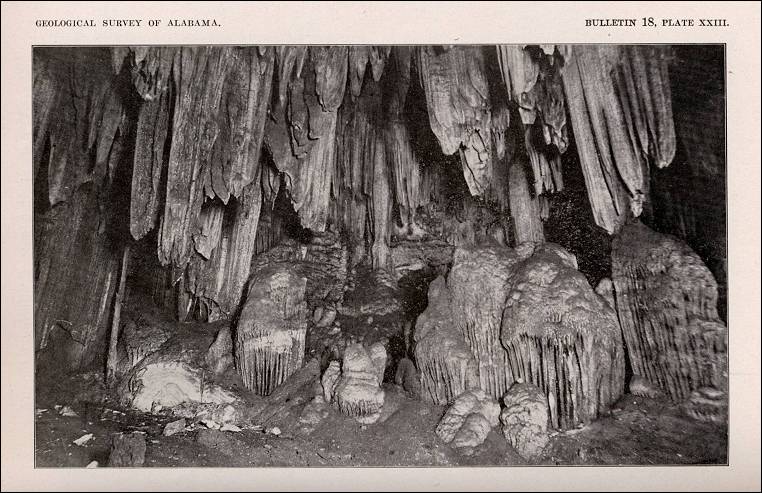
Plate XXIII. Entrance chamber in onyx-marble cave near Kymulga, Talladega County. The rock in which the cavern is formed in a dolomite. The onyx-marble deposits are calcite. (pp. 168-169) 
Plate XXIV. A. Interbedded phyllite and dolomitic marble from belt to the northwest of the crystalline marble area. The thin beds of marble have been crumpled while the thicker ones have been fractured and faulted. NE S. 33, T. 21-S., R. 3-E. (pp. 170-171) 
Plate XXV. A. One of the impurities of marble is silica. This mineral is frequently segregated into layers. Sometimes the deformation of the marble is evidenced by the bending of these layers of impurity which could not readily recrystallize. The photograph shows discarded marble block containing such evidence of folding. (pp. 172-173) 
Plate XXVI. A. Folding and reverse faulting in interbedded phyllite and marble from formation west of the crystalline marble belt. (pp. 174-175)

Plate XXVI. B. The layers of impurities, which mark roughly the position of the bedding plane, are here seen irregularly distributed through the block of marble. This is attributed to drag-folding. (pp. 174-175) 
Plate XXVII. A. In the crystalline marble deposits the marble beds are in many places interstratified with dolomite or contain lenses of dolomite, similar to the chief marble deposits of Vermont. dolomite is less readily recrystallized than calcite and when movements have taken place in the marble beds the dolomite is frequently broken and left in angular fragments or breccia, usually cement with calcite. A portion of a core which was taken from such a broken dolomite layer is here shown. The dark portion is dolomite and the lighter is calcite. (from Preliminary Report on The Crystalline and Other Marbles of Alabama, Bulletin 18,” by William F. Prouty, Geological Survey of Alabama, 1916, pp. 176-177) 




Research Resources - Alabama
- Archives
- Alabama A&M University - State Black Archives
- Alabama Archives & Libraries, presented by FamilySearch.
- Alabama Department of Archives and History
- ALGenWeb Archives, presented by Carolyn E. Golowka.
- Archival Research Catalog, U. S. National Archives & Records Administration (NARA)
- Auburn University Libraries, Special Collections & Archives Department
- Library of Congress Digitized American Memory Collection
- National Archive (NARA) Southeast Region (Atlanta, Georgia) (Research resources of retired records)
- National Geologic Map Database, presented by the United States Geologic Survey.
- National Union Catalog of Manuscript Collections (NUCMC)
- Perry-Castañeda Library Map Collection - Alabama
- Repositories of Primary Sources - Alabama. A list of links to online resources from the Univ. of Idaho Library, Special Collections and Archives.
- Repositories of Primary Sources - Worldwide
- University of South Alabama Archives
- U. S. National Archives & Records Management (NARA)
- Historical Sources
- Alabama Archives & Libraries, presented by FamilySearch.
- Alabama Black Belt Nature & Heritage Trail, presented by the Alabama Tourism Department.
- Alabama Buildings, Structures, & Architects on the Philadelphia Architects & Buildings Project (PAB) web site. You can search the database for buildings, structures, and architects either as a visitor or you can register free. You cannot search for specific cities, but you can search for county locations. There are no photographs presented, but the location and/or address and the name of the architect are included if known; and the historic registration information is also included.
- Alabama Capitols, presented by the Alabama Department of Archives & History.
- The Alabama Collection, presented by the W. S. Hoole Special Collections Library.
- Alabama - County Historical and Genealogical Societies (by county)
- Alabama Department of Archives and History
- The Alabama Historical Commission
- Alabama Historical Association Marker Program
- The Alabama Review, A Quarterly Journal of Alabama History, Sponsored by the Alabama Historical Association, Published by the University of Alabama Press,
Editorial Office hosted by the Auburn University History Department.
- Alabama Heritage, published by the University of Alabama and the Alabama Department of Archives and History.
-
Teaching Tombstones in Tuscaloosa County, by Ian W. Brown
-
- Alabama Historical Commission
- Alabama Historical Quarterly, back issues presented by the Alabama Department of Archives and History Digital Collections. (The Alabama Historical Quarterly was published from 1930 to 1982 by the Alabama Department of Archives and History (ADAH).)
-
Alabama History, presented by Sweet Home Alabama.
- Alabama History and Genealogy Project
- Alabama History Books and Articles, presented by Questia.
- Alabama History On-Line
- Alabama History - Outline of Alabama History, presented by Alabama Genealogy.
- Alabama History and Museums
- Alabama History Resources - Alabama GenWeb Project web site
- Alabama History Timelines - From Preshistory to Modern Day, presented by the Alabama Department of Archives and History (ADAH).
- Alabama Internet Resources, presented by the Alabama Department of Archives and History (ADAH).
- Alabama Local History Network
- Alabama Map - 1818, presented on the Washington County, AlGenWeb Project web site.
- Alabama Maps, Center for Business and Economic Research
- Alabama Maps (1847-1929), Library of Congress, American Memory.
- Alabama Maps, The Perry-Castañeda Library Map Collection, The University of Texas at Austin.
- Alabama Maps, University of Alabama.
- Alabama Moments in American History, presented by ADAH, Alabama Department of Archives and History.
- The Alabama Review – Table of Contents
- Alabama State Capitol Tour
- Alabama State Parks
- Alabama Tourism Department
- AlGenWeb Project Web Site (history and genealogical resources)
- American Folklife Center - The Library of Congress' repository for American folk music and folklore and folklife collections.
- American Life Histories - Manuscripts from WPA Writers’ Project (1936-1940), Library of Congress - American Memory.
- American Local History Network - Alabama (genealogy and history)
- American Memory - the Library of Congress' gateway to primary source materials relating to the history and culture of the United States. “Mission: American Memory provides free and open access through the Internet to written and spoken words, sound recordings, still and moving images, prints, maps, and sheet music that document the American experience. It is a digital record of American history and creativity. These materials, from the collections of the Library of Congress and other institutions, chronicle historical events, people, places, and ideas that continue to shape America, serving the public as a resource for education and lifelong learning.”
- Architecture of the United States, presented by Glass, Steel, and Stone.
- Courthouses Recorded by Historic American Buildings Survey (HABS) and the Historic American Engineering Record (HAER)
- Encyclopedia of Alabama
- Geoarcheology at South Alabama, presented by the University of South Alabama.
- Ghost Towns of Alabama
- Google Book Search: You can use Google Book Search to search for specific subjects in thousands of books available through the Google Book Search - both books under copyright and in the public domain. Hundreds of books are added regularly, so check back if you do not find books on the subject for which you are seeking information.
- Guide to 50 States - Alabama
- A Guide to Common Alabama Grave Markers (Cemetery Glossary), preserveALA, Alabama Historical Commission.
- Historic Federal Buildings – Search “Built in America,” presented by the Library of Congress, American Memory.
- Historical Construction Equipment Association
- Historical Map Archives - Alabama, presented by the University of Alabama.
- History of Alabama and Incidentally of Georgia and Mississippi, from the Earliest Period (1851), by Albert James Pickett.
- Internet links for Resources on Alabama History, presented by Auburn University.
- Library of Congress Digitized American Memory Collection
- Linkpendium - Alabama (genealogy and history resources)
- Making of America (MOA) Making of America is a digital library of primary sources in American social history from the antebellum period through reconstruction.
-
Marble, the official Alabama Rock, photograph and history presented in the Alabama Symbols, Emblems, and Honors for Kids, on the Alabama Archives web site.
- The Museum of East Alabama
- National Archive (NARA) Southeast Region (Atlanta, Georgia) (Research resources of retired records)
- The National Parks Service - History and Culture
- National Register - Online Travel Itineraries in the United States
- The Nineteenth Century in Print: The Making of America in Books and Periodicals. A distributed digital library collaboration at the Cornell University Library - Library of Congress - American Memories.
- Penny Postcards from Alabama, a USGenWeb Project web site, presented by Joy Fisher.
- Perry-Castañeda Library Map Collection
- Railways - A Summary of the State of Railroads in the United States, Including the Prospects for a Pacific Railroad, from the Report of the Superintendent of the Census for December 1, 1852 - Seventh Census. Web site presented by the Central Pacific Railroad Photographic History Museum.
- Repositories of Primary Sources – Worldwide
- Resources for Historians – The History Guide, presented by Steven Kreis.
- Ruffner Mountain Nature Center, 1214 81st Street South, Birmingham, AL 35206
Mining sites, quarries and mining equipment remain on Ruffner Mountain from the many iron ore mines that dotted the landscape from the 1880s to the 1950s.
- Theses and Dissertations on Topics in Alabama History Submitted for Masters or Doctoral Degrees at Alabama Colleges and Universities, 1900 through 1996, and at Non-Alabama Institutions of Higher Education, 1900 through 1996, presented by the Alabama Department of Archives and History (ADAH).
- WPA Life Histories From Alabama
- Libraries
-
Alabama Archives & Libraries, presented by Family Search.
- Alabama Department of Archives and History
- Alabama Virtual Library (for Alabama residents)
- Auburn University Libraries - Aubiecat
- Archives and Manuscripts Department, University of Auburn
- Auburn University Special Collections
- Archives and Manuscripts Department, University of Auburn
- Internet Public Library
- Library of Congress Digitized American Memory Collection
- National Archive (NARA) Southeast Region (Atlanta, Georgia) (Research resources of retired records)
-
- Museums
- Alabama History and Museums
- Alabama Mining Museum, 120 East Street, Dora, Alabama 35062; (205) 648-2442.
- Alabama Museum and Historic Site Directory
- Alabama Museum of Natural History, Smith Hall, University of Alabama, Tuscaloosa, Alabama.
- Alabama Museums, presented by epodunk.
- Alabama Museums Association
- Anniston Museum of Natural History, Annisto, Alabama.
- Baldwin County Heritage Museum, 25521 U.S. Highway 98, Elberta. Mailing address: P.O. Box 356, Elberta, AL36530. Phone: (334) 986-8375.
- Heart of Dixie Railroad Museum, Calera, Alabama.
- Historical Museums of Alabama
- Mineral and Fossil Museums, Exhibits, & Displays in the United States - Alabama
- Monroe County Heritage Museums
-
Museums, Parks, and Places with Geologic and Earth Science Exhibits
- North Alabama Railroad Museum
- Old Depot Museum, (location) 4 Martin Luther King Street, Selma, AL 36702, (mailing address) P. O. Box 1391
Selma, AL 36702-1391. - Pioneer Museum of Alabama, 248 Old Highway 231 N, Troy, AL 36081-2459; (334) 566-3597.
- Other
- 1895 U.S. Atlas - Alabama
- Alabama Almanac, presented by Netstate.com.
- The Alabama Information Directory
- Alabama Scenic Byways, presented by the National Scenic Byways Program.
- Alabama Travel Tips (locations)
- Alabama Tourism Department
- Alabamiana - A Guide To Alabama
- Cyndi's List - Online Research Resources - Alabama
-
Discovering Alabama, by the University of Alabama.
- Google - Local (Use Google’s Local Map, Satellite, and Hybrid (combination map and satellite image) views to view locations of your choice. Be sure to designate the location in the search field in the Google - Local window.)
- Guide to 50 States – Alabama
- Info Please - Encyclopedia - Alabama
- National Geologic Map Database, presented by the United States Geologic Survey.
- Things To Do in Alabama
- Topographic Maps and Atlases
- TopoZone “The TopoZone is the Web's center for recreational and professional topographic map users.” (Includes a place name search form.)
- US Board on US Geographic Names - The New U.S. and Territories Query (Search the USGS Geographic Names Database.)
-
Virtual Field Trips on Discovering Alabama, by the University of Alabama.
- World Almanac for Kids Online - Alabama
- WorldAtlas.com - Alabama
- Yale
Peabody Museum: GNIS (Search
the USGS Geographic Names Database)
Printed & Online Sources
NOTE: You can obtain Alabama Geological Survey publications from the publications section of the web site.
Google Book Search: You can use Google Book Search to search for specific subjects in thousands of books available through the Google Book Search - both books under copyright and in the public domain. Hundreds of books are added regularly, so check back if you do not find books on the subject for which you are seeking information.
- Active Mines and Quarries of Alabama (Map), compiled by Mirza A. Beg and I. David George, 1975 edition, publisher: Tuscaloosa, Alabama, Geological Survey of Alabama, 1975.
- Alabama, A Bicentennial History, by Virginia Van der Veer Hamilton, Nashville: American Association for State and Local History, 1977.
- Alabama: A Documentary History to 1900, by Lucille Griffith, University: University of Alabama Press, 1950.
- Alabama Historical Quarterly - Table of Contents. The Alabama Historical Quarterly was published from 1930 to 1982 by the Alabama Department of Archives and History (ADAH).
- “Alabama Marble, History, Production, and Use,” in Mine and Quarry Magazine, Sullivan Machinery Co., Chicago, 1908, pp. 246-250. [photo captions: “Gantt’s Quarry, Alabama (p. 246); “Quarry blocks of Alabama marble.” (p. 247); “Quarry of Alabama White Marble Co., Gantt’s Quarry, Alabama, showing Single- and Double-Head Sullivan ‘2’ Channelers.” (p. 248); “Sullivan Side-Hill Channeler, ‘Class 6 1/2,’ in West Rutland quarry of Vermont Marble Co. Instead of winding the cable on a drum on the axle, as described in this article, the cable here passes over a sheave and is attached to a counterbalance car running on rails parallel to the machine track.” (p. 249); “Part of the mill and shipping yard, Alabama Marble Co.” (p. 250)] (This article is available in Google Book Search - Full view books in a bound book of “Mine and Quarry” magazine, although many pages are unreadable.)
-
“Alabama marble is superior, expert says,” by Matt Quillen, April 16, 2011, from “The Daily Home.”
- Alabama Piedmont Geology, Second Annual Field Trip, Guidebook, Alabama Geological Society, December 1964: University of Alabama, 64 pp.
- The Alabama Review: A Quarterly Journal of Alabama History.
- Alabama - The University of Alabama Press
- Alabama Heritage
- Alabama, Her History and Resources, War Record and Public Men, by Willis Brewer, Spartanburg: The Reprint Company Publishers, 1975 (1872).
- Alabama Historical Quarterly - Table of Contents (published from 1930 to 1982 by the Alabama Department of Archives and History (ADAH)
-
“Alabama marble called whitest in world,” February 5, 2005, The Decatur Daily News
- Alabama Railroads, by Wayne Cline, Tuscaloosa: University of Alabama Press, 1997.
- The Alabama Review
- The Alabama Story, by Robert J. Norrell, Tuscaloosa: The Yellowhammer Co., 1993.
- Alabama, The History of a Deep South State, by William Warren Rogers, Robert David Ward, Leah Rawls Atkins, and Wayne Flynt, Tuscaloosa: University of Alabama Press, 1994.
- Alabama's Mineral Industry, by T. E. Cook, M. P. Turner, and T. A. Simpson, Alabama Geological Survey Information Ser. 32, 1963, 41 pp.
- Architecture of the Old South: Mississippi / Alabama, by Mills Lane, New York: Abbeville Press, 1989.
- Atlas of Alabama Counties, by W. Craig Remington, ed., 2nd ed. Tuscaloosa: Dept. of Geography, Univ. of Alabama, 1998.
- Atlas of Historical County Boundaries, John H. Long, ed., and Peggy Sinko, comp., Alabama. New York: Simon & Schuster, 1996.
- Bibliography of the Mineral Resources of Alabama, Exclusive of Coal, Iron, and Petroleum, Circular 93, Alabama Geological Survey, 1974.
- A Brief History of Sylacauga Marble, by Ruth Beaumont Cook, written in preparation for the Sylacauga Marble Festival April 17-30, 2009, Alabama / Piestrasanta, Italy Cultural Exchange sponsored by the Alabama State Council on the Arts, A product of the B. B. Comer Memorial Public Library Foundation, Sylacauga, Alabama, 2009, 34 pp. (You can view both the The Sylacauga “Magic of Marble” Fetival brochure and program from the 2009 festival in PDF format. If you are interested in attending the next annual marble festival in Sylacauga in the spring of 2010: The festival activities will be held from March 24th through the 28th, and the marble carving will be done on March 16.)
- “A Brief History of the Marble Industry of Sylacauga,” by Edward Dodd, in Alabama Heritage, Vol. 20, Spring 1991, pp. 35-39.
- Building Sandstones of Northern Alabama, by William James Penhallegon, publisher: University, Alabama, 1940. Series: Alabama. State geologist Circular No. 13. At head of title: Geological Survey of Alabama "Published in cooperation with the Tennessee Valley Authority."
- The Cement Industry in Alabama, Alabama Geological Survey Circular 14, by E. J. Burchard, 1940, 32 pp.
- Cement Resources and Lime, Gypsum (Mussel Shoals District) (abs.), by E. C. Eckel, Alabama Acad. Sci. Jour., v. 7, 1935, pp. 35.
- The Cement Resources of Alabama, by Eugene A. Smith, Brown Printing Company, Alabama Geological Survey No. 8, 1904, 93 pp. (This book is available on Google Book Search – Full View Books for reading or downloading to your computer in PDF format.)
- Contributions to Economic Geology, Bulletin 470, 1910. Short Papers and Preliminary Reports, Part I, Metals and Nonmetals, Except Fuels, by C. W. Hayes, Waldemar Lindgren, United States Geological Survey, Washington: Government Printing Office, 1911, 558 pp. (This book includes a section on the variegated marble southeast of Calera, Shelby County, Alabama.)
- The Coosa Valley Region: Report on Valley Regions of Alabama, by Henry McCalley, Part 2, Alabama Geol. Survey, 1897.
- “The Crystalline Marbles of Alabama,” Bull. Geol. Soc. Am., vol. 27, pp. 437-450, 1916.
- Description of the Bessemer and Vandiver Quadrangles (Alabama), by Charles Butts, U.S. Geological Survey Geological Atlas, Folio 221, 1927, 22 pp.
- Description of the Montevallo-Columbiana Quadrangles (Alabama), by Charles Butts, U.S. Geological Survey Geological Atlas, Folio 226, 1940b, 20 pp.
- Directory of Commercial Minerals in Georgia and Alabama Along the Central Georgia Railroad, T. P. Maynard, J. M. Mallory, and R. T. Stull, Savannah, Georgia: Central of Georgia Railway Indus. Dept., 1923, 134 pp.
- Exploring Alabama Caves, Bulletin 102, by Thomas W. Daniel, Jr., and William D. Coe, 1973. (PDF) 45.2 MB (This online publication is available on the Alabama Geological Survey web site.)
- General Geology and Ground-Water Resources of Limestone County, Alabama, by W. M. McMaster and W. F. Harris Jr., Alabama Geological Survey County Report 11, 1963, 43 pp.
- Geologic Map of Alabama, by Charles Butts, Montgomery Alabama: Alabama Geological Survey, 1926.
- Geologic Map of Limestone County, Alabama, 33x36 inches. Colored, SM 13, Alabama Geological Survey, 1960.
- Geologic Map of Tuscaloosa and Cottondale Quadrangles, Alabama, Showing Areal Geology and Structures of Upper Cretaceous Formations, by L. C. Conant, D. H. Eargle, W. H. Monroe, and J. H. Morris. U.S. Geological Survey Oil and Gas Preliminary Inv. Map 37, scale 1 inch=1 mile, 1945. (map)
- Geological Map of Alabama: Chart to Accompany Geological Map of Alabama, E. A. Smith, and assistants, Geological Survey, Alabama, 1894.
- Geological Survey of Alabama Report of Progress For 1874, by Eugene A. Smith, 1875, 129 pp.
- Geology and Ground-Water Resources of Cherokee County, Alabama, Bulletin 79 (A Reconnaissance), by Lawson V. Causey, 1965. (PDF) 2.74 MB (This online publication is available on the Alabama Geological Survey web site.)
- Geology and Ground-Water Resources of Greene County, Alabama, Bulletin 86, by Kenneth D. Wahl, 1966. (PDF) 20.0 MB (This online publication is available on the Alabama Geological Survey web site.)
- Geology and Ground-Water Resources of Montgomery County, Alabama, Bulletin 68, Part A, by D. B. Knowles, H. L. Reade, and J. C. Scott, 1963. (with special reference to the Montgomery area). (PDF) 28.9 MB. (This online publication is available on the Alabama Geological Survey web site.)
- Geology and Ground-Water Resources of St. Clair County, Alabama, Bulletin 73, (A Reconnaissance) by Lawson V. Causey, 1963. (PDF) 4.78 MB (This online publication is available on the Alabama Geological Survey web site.)
- Geology and Ground-Water Resources of Tuscaloosa County Alabama, An Interim Report, Information Series 14, by J. D. Miller, Jr., and L. V. Causey, University, Alabama, 1958 (PDF) 10.9 MB (This online publication is available on the Alabama Geological Survey web site.)
- Geology and Marble Resources of the Sylacauga Marble District, Bulletin 131, Alabama Geological Survey, 1989.
- The Geology and Mineral Resources of Cherokee County, Alabama, by Edgar Bowles, Alabama Geological Survey Circular 15, 1941, 38 pp.
- Geology and Mineral Resources of Clay County, with Special Reference to the Graphite Industry, Circular 1, Alabama Geological Survey, 1923. (Also issued as Special Report 12.) (out of print)
- The Geology and Mineral Resources of Limestone County, Alabama, A Reconnaissance Survey, Circular 46, Alabama Geological Survey, 1968. (out of print)
- Geology and Mineral Resources of the Fisk quadrangle (Madison Co.), Alabama, QS 5, Alabama Geological Survey, 1975.
- Geology and Mineral Resources of the Leighton Quadrangle (Colbert Co.), Alabama, QS 7, Alabama Geological Survey, 1975.
- Geology and Mineral Resources of the Moontown Quadrangle (Madison Co.) Alabama, QS 1, Alabama Geological Survey, 1975.
- Geology and Mineral Resources of the New Hope Quadrangle (Madison Co.), Alabama, S 3, Alabama Geological Survey, 1975.
- Geology and Mineral Resources of the New Market Quadrangle (Madison County), Alabama, QS 8, Alabama Geological Survey, 1982.
- Geology and Mineral Resources of the Pride Quadrangle (Colbert Co.), Alabama, QS 4, Alabama Geological Survey, 1975.
- Geology and Mineral Resources of the Toney Quadrangle (Madison Co.), Alabama, QS 2, Alabama Geological Survey, 1975.
- Geology and Mineral Resources of the Town Creek Quadrangle, (Colbert and Lawrence Cos.) Alabama, QS 12, Alabama Geological Survey, 1993.
- Geology and Mineral Resources of the Tuscumbia Quadrangle [Colbert Co.], Alabama, QS 6, Alabama Geological Survey, 1975.
- Geology of Alabama, by G. I. Adams, Charles, L. W. Stepheneson, and Wythe Cooke, Alabama Geological Survey Spec. Rept. 14, 1926, 312 pp.
- Geology of Gantt’s Quarry and the Sylacauga Marble, by A. S. Glover, Georgia Marble Company, Alabama Calcium Products Division, 1983.
- Geology of the Elkmont Quadrangle, Alabama-Tennessee, by W. M. McMaster, U.S. Geological Survey Misc. Geological Inv. Map I-419, 1965a, 7 pp. (map)
- Geology of the Salem Quadrangle, Alabama-Tennessee, by W. M. McMaster, U.S. Geological Survey Miscellaneous Inv. Map I-420, 1965b, 10 pp. (map)
- Geology of the Southern Inner Piedmont, Alabama and Southwest Georgia, Guidebook 3-7, by Mark G. Steltenpohl, Stephen A. Kish, and Michael J. Neilson, Guidebook for Field Trip 7, for 39th Annual Meeting, Southeastern Section, Geological Society of America, Tuscaloosa, Alabama, April 7-8, 1990 (PDF) 21.2 MB (This online publication is available on the Alabama Geological Survey web site.)
- “Giuseppe Moretti,” in the Encyclopedia of Alabama.
- “ Giuseppe Moretti,” in Alabama Heritage, by Jennifer M. Willard, No. 20, Spring 1991.
- Giuseppe Moretti: Master Sculptor and Father of Vulcan, Birmingham Museum of Art, from the 2002 exhibition, ISBN 10: 0931394511, 32 pp., 0-931394-51-1, ISBN 13: 9780931394515.
- A Guidebook To The Mississippian Rocks and Fossils of North Alabama, ES 13, Alabama Geological Survey, 2000.
- The Gulf South Historical Review - Table of Contents (formerly titled The Gulf Coast Historical Review – description of book available on Google Books)
- Herd Family Records located in the B. B. Comer Library Collection.
- High Calcium Deposits in the Newala Limestone, Circular 149, Alabama Geological Survey, 1990.
-
A High-Resolution Palynological Analysis Of The St. Stephens Quarry, Alabama: Locating The Eocene-Oligocene Boundary And Characterizing The Environmental Changes Across The Margin, A Thesis Submitted to the Graduate Faculty of the Louisiana State University and Agricultural and Mechanical College In fulfillment of the Requirements for the degree of Master of Science in The Department of Geology and Geophysics, By Kevin Jensen B.S., Central Michigan University, 2009 May, 2012.
- Historic Alabama Hotels and Resorts, by James Frederick Sulzby, University: Univ. of Alabama Press, 1960.
- History of Alabama, by Albert James Pickett, Tuscaloosa: Willo Publishing Company, 1962 (1851).
- History of Alabama and Dictionary of Alabama Biography, by Thomas M. Owen, Spartanburg: The Reprint Company Publishers 1978 (1921). (The 1921 version of this book is available on Google Book Search – Full View Books.)
- “History of Talladega County Prior to the Civil War,” in Moore’s History of Alabama, Stanley Brooks Russell, Vol. 2, 1927, pp. 781.
- Index to the Mineral Resources of Alabama, with map and illustrations, E. A. Smith and Henry McCalley, Geological Survey of Alabama, 1904, 79 pp. (Some of the contents include: The Stone: Limestones & Dolomite, Marbles, & Lithographic Stone; Clays & Cement; Building Stones: Limestones, Sandstones, Granites & Other Igneous Rocks, Paving & Curbstones; Slates; Road & Ballast Materials; & Millstones, Grindstones, and Whetstones.) (This book is available on Google Book Search – Full View Books for reading or downloading to your computer in PDF format.)
- Index to the Mineral Resources of Alabama, by W. B. Jones, Alabama Geological Survey Bulletin 28, 1926, 250 pp.
- Index to the Minerals and Rocks of Alabama, by H. D. Pallister, Alabama Geological Survey Bulletin 65, 1955, 55 pp.
- Industrial Minerals of the Southeastern United States-Economic Mineral Resources in Central Alabama, Guidebook 3-3, by Karen F. Rheams, Guerry H. McClellan, Guidebook for Field Trip 3, for 39th Annual meeting, Southeastern Section, Geological Society of America, Tuscaloosa, Alabama, April 4, 1990 (out of print) (PDF) 6.10 MB (This online publication is available on the Alabama Geological Survey web site.)
- Know Alabama! The Geology and Mineral Resources of Alabama, Bulletin 51, (with) a bibliography for schools, Alabama Geological Survey, 1942. (out of print)
- “Limestone and Dolomite in the Birmingham District, Alabama,” by Charles Butts, in Bulletin 315, Department of the Interior, United States Geological Survey, Government Printing Office, Washington, D. C., 1907, pp. 247-255. (Available on Google Books.)
- Limestone Resources of Alabama, SM 172, Alabama Geological Survey, 1984.
- A Location Guide for Rockhounds, (PDF) Collected by Robert C. Beste, PG, St. Louis, Missouri: Hobbitt Press, 2nd ed., December 1996, 148 pp. (Includes chapters on “Mineral Locations by State,” “Appendix and Glossary,” and “Bibliography.”)
- "Marble Formation of the Cahaba River, Alabama," by P. Byrne, Eng. and Min. Jour., vol. 72, 1901, p. 400; Trans. Eng. Assoc. South, Vol. 12, 1902, pp. 48-59.
-
The Alabama “Marble Industry,” by Michael Kief Law, Auburn University, presented on the Encyclopedia of Alabama.
- The Materials and Manufacture of Portland Cement, by Edwin C. Eckel, Geological Survey of Alabama Bulletin No. 8, Brown Printing Company, 1904, 93 pp. (This book is available on Google Book Search – Full View Books for reading or downloading to your computer in PDF format.)
- Mercer Collection, located in the Archives of the Birmingham Public Library.
- Mineral Resources Map of Alabama, 17x22 inches. Colored, SM 124, Alabama Geological Survey, 1973.
- Mineral Resources of the Alabama Piedmont, Basic data, SM 200, Alabama Geological Survey, 1984.
- Mineral Resources of the Appalachian Region, Geological Survey Professional Paper 580, United States Geological Survey and the U. S. Bureau of Mines, Washington: U. S. Government Printing Office, 1968, 492 pp. (Covers these states: Alabama, Georgia, Kentucky, Maryland, New York, North Carolina, Ohio, Pennsylvania, South Carolina, Tennessee, Virginia, and West Virginia.)
- Mineral Resources Map of Alabama, 17x22 inches. Colored, SM 124, Alabama Geological Survey, 1973.
- Mineral Resources of the Valley and Ridge Province, Alabama, Bulletin 147, Alabama Geological Survey, 1992.
- “Mining Alabama’s Carrara: The Forgotten History of Sylacauga’s Marble Industry,” by Ruth Beaumont Cook, Alabama Heritage, Winter 2012, Issue 103.
- Modern Memorial Designs: America’s Most Beautiful White Marble, written and published by Moretti-Harrah Marble Corp., Sylacauga, Alabama, 1936.
- Moretti Collection located in the Archives of the Birmingham Public Library.
- Natural Resources of the Tennessee Valley Region in Alabama, by R. M. Harper, Alabama Geological Survey Spec. Report 17, 1942, 93 pp.
- Northern Alabama: Historical and Biographical, Smith & DeLand, Birmingham, Alabama, Donohue & Henneberry, Printers and Binders, Chicago, 1888, 776 pp. (Part I. Topography, Geology and Natural Resources of Northern and Central Alabama, & Part II. Summary of the State’s History from Its Earliest Settlement to the Present Time.) (Available on Google Books & the Internet Archives - Texts)
- “Old Marble Tombstones in Alabama,” by Carolyn L. Luttrell, a paper read at the annual meeting of the Alabama Historical Association, University of Alabama, on April 16, 1949 . Subsequently published in the July 1950 issue of The Alabama Review.
- Place Names in Alabama, by Virginia O. Foscue, Tuscaloosa: University of Alabama Press, 1989.
- Preliminary Report on the Crystalline and Other Marbles of Alabama, Bulletin 18, with a Preliminary Map of The Crystalline Marble Deposits of Alabama, by William F. Prouty, Alabama Geological Survey, 1916, 212 pp. (Available on Google Books and the Internet Archive.)
- Railroads in Alabama Politics: 1875-1914, by James F. Doster, University: University of Alabama Press, 1957.
-
Re-Mapping St. Stephens Quarry, Alabama: An Undergraduate Student Research Project With Geological And Archaeological Applications, Justin A. Hayles, Amanda D. Lemler, and Douglas W. Haywick, W., Earth Sciences, University of South Alabama, March 2010. (abstract) Presented on the Geological Society of America (GSA) web site.
- Report on the Valley Regions of Alabama (Paleozoic strata). Pt. 2, On the Coosa Valley Region, by Henry McCalley, Montgomery, Alabama, Alabama Geological Survey, 1897, 862 pp. (Available on Google Books and the Internet Archive.)
- Rivers of History: Life on the Coosa, Tallapoosa, Cahaba, and Alabama, by Harvey H. Jackson, Tuscaloosa: Univ. of Alabama Press, 1995.
- “Rural Southern Gravestones: Sacred Artifacts in the Upland South Folk Cemetery,” by Donald Gregory Jeane, Markers IV, pp. 55-84, Association for Gravestone Studies. (Alabama, Arkansas, Florida, Georgia, Kentucky, Louisiana, Mississippi, North Carolina, Oklahoma, South Carolina, Tennessee, Texas, Virginia, West Virginia, USA)
- The Salt Mountain Limestone of Alabama, B 46, Alabama Geological Survey, 1940.
- Second Biennial Report on the Geology of Alabama, Tuomey, 1858, (information on Alabama marble pp. 116-121).
- Selected Industrial Mineral Resource Sites and Processing Facilities in West Alabama, Field Trip Guidebook For Short Course on Valuation of Industrial Mineral Resources, November 18-21, 1991, University of Alabama, Tuscaloosa, Alabama, GB 4, Alabama Geological Survey, 1991.
-
St. Stephens Historical Commission, Functional Analysis & Records Disposition Authority, presented to the State Records Commission, April 26, 2001.
- “Statistics of Mineral Production for 1914,”Bulletin 16, Geological Survey of Alabama, 1915, pp. 60-62.
- Statistics of the Mineral Production of Alabama for 1925, by W. B. Jones, Alabama Geological Survey Bulletin 34, 1928a, 185 pp.
- Structural Analysis of Sheath Folds in the Sylacauga Marble Group, Talladega Slate Belt, Talladega County, Alabama, Circular 164, Alabama Geological Survey, 1992.
- Structural Development of the Southernmost Appalachians, Third Annual Field Trip, 1965, Guidebook, Alabama Geological Society, University of Alabama, 69 pp.
- Structure and Petrography of the Hillabee Sill and Associated Metamorphics of Alabama, by R. H. Griffin, Alabama Geological Survey Bulletin 63, 1951, 74 pp.
- Summary Report on the Building Limestones of the Russellville District (Alabama), C 8, Alabama Geological Survey, 1928.
- Summary Report on the Mineral Resources of Southwest Alabama, IS 65, Alabama Geological Survey, 1986.
-
“Sylacauga marble,” presented on Wikipedia.
-
Synergy – Alabama Limestone Company Cathedral Stoneworks – The Alabama Columns, presented on Cathedral Stone Works
Following is an excerpt from Synergy – Alabama Limestone Company / Cathedral Stoneworks – The Alabama Columns:
“Alabama Limestone Company: founded in 1827, set in the Appalachian piedmont of northwestern Alabama, with a 32-ft. tall seam of pure ‘Shadow Vein’ oolitic limestone....”
“Cathedral Stoneworks: founded in 1989 in Harlem, a high-tech, all-stone fabrication resource for the 21st century that’s building a cathedral, teaching 13th-century stonecraft to local apprentices, and is ‘...among the most up-to-date stoneworking factories in the world,’ according to Stone World magazine.
“The Alabama Column: an emblem of synergy, 23-ft. tall, carved in Shadow Vein limestone in situ into the side of the quarry and embellished with reliefs depicting Alabama state emblems (the red-bellied turtle, the pecan, et al). Fifteen tons of stone were blasted from the site; 5000 bore holes were drilled. A team of New York master carvers and Alabama masons completed the project in three months. ‘Abu ‘Bama,’ they named it, after its inspiration, the Egyptian temple of abu simbel.
“Synergy: ‘working together.’ Alabama Limestone Company and Cathedral Stoneworks combine stone-age materials and space-age technologies to create an innovative American resource that’s the talk of the industry....”
- The Technology of Marble Quarrying, U. S. Bureau of Mines Bulletin 106, by Oliver Bowles, Washington: Government Printing Office, 1916.
-
“Teen discovers rare fossil in Alabama quarry,” by Amanda Bayhi, July 19, 2013, on the AggMan web site. (in a Greene County quarry)
- Thin Bedded Sandstones of the Guntersville Area, (Alabama), by Charles E. Hunter, with the cooperation of George L. Richardson, Series: Alabama. State Geologist Circular No. 12, publisher: University, Alabama, 1940, 31 pp.
- University of Alabama Press
- The Valley Regions of Alabama, by Henry McCalley, Pt. II, Alabama Geological Survey, 1897.
- "Variegated Marble Southeast of Calera, Shelby County, Alabama," by Charles Butts, Bull. U. S. Geol. Survey No. 470, 1911, pp. 237-239.
Stone Carvers, Stone Cutters, etc., in Alabama
- Early Grave Stone Carvers in or Near Greene County, Alabama, presented on by the ALGenWeb web site, by Kim Jacobson.
The following stone carvers’/company names are listed on this web site in addition to photographs of cemetery stones that they signed: Alexander HERD, Eutaw, Alabama; HERD & Bros., G. Herd; Thomas H. HOLT, Birmingham, Alabama; and B. J. HUGHES, Vienna, Alabama.
- Giuseppe Moretti, Sculptor - Giuseppe Moretti by Jennifer M. Willard, Alabama Heritage, No. 20, Spring 1991, site of the Birmingham Public Library, Birmingham, Alabama. One of the cities that Mr. Moretti worked and created his pieces was in Pittsburgh, Pennsylvania.
- Moretti Collection located in the Archives of the Birmingham Public Library.
- Sylacauga, Talladega County, Alabama – Giuseppe
Moretti, Italian Sculptor & Quarry Operator,
from A brief history of Sylacauga Marble, by Ruth
Beaumont Cook, B. B. Comer Memorial Public Library Foundation,
2009, pp. 6, 11-17.
According to this book, Giuseppe Moretti quarried and promoted the use of Sylacauga marble for statuary and construction. Photographs of Giuseppe Moretti’s works and studio and home are included.
- Giuseppe Moretti – the following excerpts of the history of Giuseppe Morette are from the Encyclopedia of Alabama.
“Giuseppe Moretti (1857-1935), an Italian-born classical sculptor, made an extraordinary impact on the state of Alabama through his design and execution of Birmingham’s 56-foot iron statue of Vulcan and his promotion of Alabama marble as a medium for fine sculpture…..”
“…Moretti decided to find a way to buy land and establish his own quarry in Alabama. He hauled a sample block of the gleaming white stone back to his studio in Birmingham and carved The Head of Christ, a work that he carried with him to every place that he lived for the rest of his life…..”
- Giuseppi Moretti – Marble Quarry, 1935 (Photograph in the Encyclopedia of Alabama)
Marble Quarry, 1935
“During the early twentieth century, Italian sculptor Giuseppe Moretti, whose first contribution to Alabama was the Vulcan statue in Birmingham, used Sylacauga marble for a number of his works. During the 1930s the marble industry fought the Great Depression and saw larger operations such as the Alabama Marble Company absorb smaller ones.”
-
Giuseppe Moretti’s House and Studio, 4029 Bigelow Blvd., Pittsburgh, Pennsylvania.
According to this web site, Moretti “spent many years in Pittsburgh ( Pennsylvania) which characterized the years spanning from 1916 to 1930 with the house and studio at 4029 Bigelow Avenue. Construction of the ‘facility’ cost roughly $30,000 and was finished in cream-colored brick with trimmings of Alabama Marble….”
Commercial use of material within this site is strictly prohibited. It is not to be captured, reworked, and placed inside another web site ©. All rights reserved. Peggy B. and George (Pat) Perazzo.